
Tralee Golf Links: Arnold Palmer’s First European Course and the Back Nine That God Designed
Reading time: 5 minutes
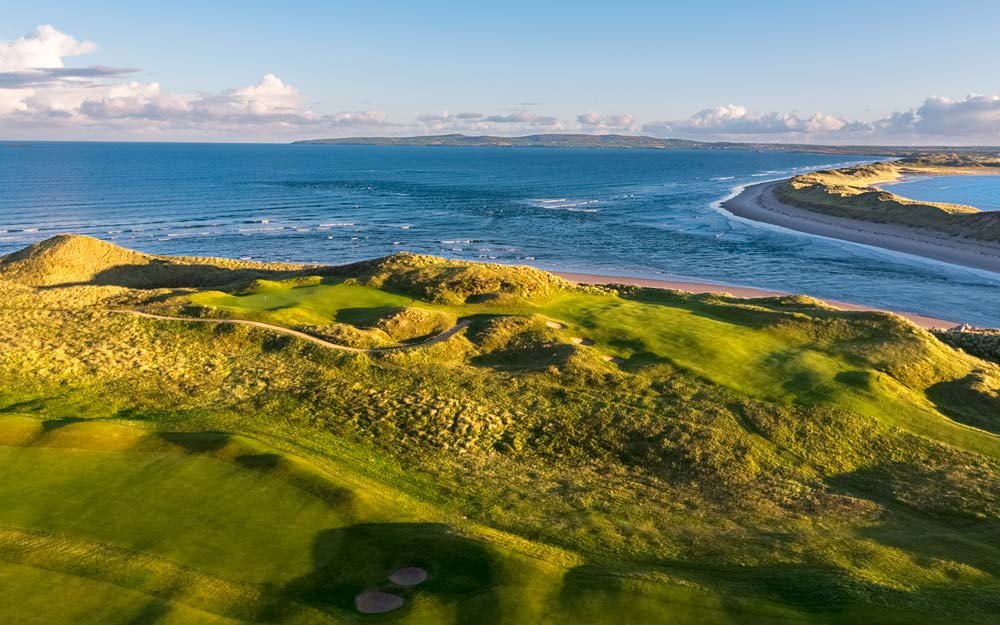
In 1981 Arnold Palmer flew to a stretch of dune-land at West Barrow on the Kerry coast, looked out at the Atlantic and the Dingle Peninsula across the water, and reportedly said he had never come across a piece of land so ideally suited for the building of a golf course. Three years later, his first European design opened. Palmer was always quick to qualify the credit. "I designed the first nine," he liked to say, "but surely God designed the back nine."
That line is the most famous thing ever said about Tralee, and after a round here you understand why. The front nine is solid Palmer architecture, generous fairways, fair tests, a steady build. The back nine is something else: a wild, dune-strewn coastline of cliff-top tee boxes and crashing surf where the design is more discovery than construction. Palmer himself said it. The land at Barrow was not made by an architect.
At a Glance
Course: Tralee Golf Links (West Barrow), Co. Kerry
Type: Links
Founded / opened: Club instituted 1896; present links at Barrow opened October 1984
Main architects: Arnold Palmer with Ed Seay (1984)
Par / back tee yardage: Par 72; plays to nearly 7,000 yards from the back tees, depending on setup
Best paired with: Ballybunion, Lahinch and Waterville on a Southwest week
Practical note: Demanding clifftop back nine; buggies are permitted for visitors, a useful exception among Irish links.
The Course: From Mounthawk to Barrow
Tralee Golf Club dates to 1896, though the present links at Barrow is a much newer Arnold Palmer design from 1984. For most of its first century the club played a quiet nine-hole parkland course at Mounthawk, a few minutes from the town. By the early 1980s the membership wanted a links worthy of its setting on the Atlantic, and the move was made to a hundred acres of duneland at West Barrow, twenty minutes from the town centre.
Palmer arrived with his chief architect, Ed Seay. The brief was simple, make use of the cliffs, the duneland, and the view across to the Dingle Peninsula. The course opened in October 1984. It was the first Arnold Palmer course in Europe, and remains the one Palmer himself spoke about most warmly when asked about his international design portfolio.
Earlier still, the same dune-land had a brush with cinema. In the spring and summer of 1969, David Lean shot scenes for Ryan's Daughter on the beaches at Barrow and at neighbouring Inch. Some of the most photographed shoreline in Irish film history is the same shoreline you walk during the back nine.
The Signature Holes
The 3rd, "The Castle": A 194-yard par-3 along the cliff edge, played to a green tucked beside a 15th-century stone watchtower, the actual ruined tower remains there, just behind the green, as it has for six centuries. The shot demands the right club and the courage to commit; the hole, with its medieval backdrop and the Atlantic spread below, is one of the most photographed in Ireland.
The 12th, "Culin": A 594-yard par-5 played over heaving duneland on the opening section of the back nine. The drive is uphill into the wind on most days; the second shot is into a fairway that twists between dunes; and the green sits in a natural amphitheatre. A hole where a four feels like a small heroic act.
The 16th, "Shipwreck": Named for the broken coast that earned the local nickname "graveyard of the Spanish Armada," after the galleons of the 1588 fleet that came to grief on these rocks. The hole plays right along that shore. It is the kind of par-4 where standing on the tee, looking down at the surf, the round briefly stops being about the score.
The closing stretch: The walk in from 16 to 18 is the moment the trip locks in. Cliff-top tee boxes, the Atlantic on your right, and the sense, uncommon in golf, that you are walking through a landscape that has not been edited.
The Tralee Experience
The clubhouse at Barrow is modern, low-slung, and built to take advantage of the view: the deck looks across to the Dingle Peninsula and the Slieve Mish mountains, and the bar pours one of the better Guinnesses in Kerry. The terrain is genuinely demanding, the back nine in particular has elevation changes most Irish links do not, and a buggy is allowed for visitors who need one (most clubs in Ireland are walking-only; Tralee is a useful exception).
Caddies here are serious, and they know the wind tricks the Atlantic plays at Barrow. They will tell you which cliff-edge tees the prevailing breeze pushes a tee shot toward, and which seemingly-safe fairway shots will run into trouble on a firm summer's day.
The course is exposed. There are days at Tralee when the wind off the Atlantic will not let you put on a hat, and days where the sun is out and the bay flat as a mirror. Either way, you will remember it.
Getting There and What's Nearby
Tralee sits about an hour from Kerry Airport, twenty minutes from the town of Tralee itself, and roughly forty-five minutes from the start of the Dingle Peninsula. A trip built around Tralee almost always pairs with a day on Dingle, the drive west out of town along the coast road is among the most spectacular in Ireland, taking in Inch Beach (the same one from Ryan's Daughter), Slea Head, and the village of Dingle, where Foxy John's bar still sells half-pints and bicycle parts under the same roof.
The town of Tralee has a decent supply of restaurants and a healthy traditional-music scene. For golf groups looking to base themselves close to the course, the Listowel Arms and the Ballygarry House Hotel are both within easy reach.
Why Tralee Belongs on Your List
Tralee is a course that golfers either rate as a top-three round of the Ireland trip or remember for the back nine alone. The reason is straightforward: very few championship links anywhere in the world have a stretch of holes as wild as 11 through 17 at Barrow. The cliffs are real cliffs, the beach is the same beach David Lean filmed, and the watchtower behind the third green is the same tower it has been since the 1400s.
For a southwest Ireland itinerary, Tralee pairs naturally with Ballybunion, Lahinch, and Waterville. Among those four, Tralee is the one that surprises visitors most, partly because of the Palmer pedigree, partly because of the back nine, and partly because not many golfers know it carries the same level of design and setting as the more famous names down the coast.
Planning Your Visit to Tralee
Tralee welcomes visitors and makes a dramatic Kerry round, with Arnold Palmer's celebrated back nine through the dunes.
Book well ahead: Tralee is a sought-after Kerry links, so reserve your dates in advance, mornings especially.
Proof of handicap: bring proof of an official handicap; the club can ask to see it.
Caddies: caddies know how the wind moves across the links and are well worth taking; request one ahead.
Buggies: buggies are permitted for visitors, though the links rewards walking where you can.
Green fees: Tralee sits among the higher green fees in the South West, in keeping with its standing.
We arrange tee-time requests at Tralee and chauffeured transfers from Kerry or Shannon Airport.
Tralee is a regular feature in Argyle Links' Kerry and Southwest Ireland packages. We arrange tee-time requests, coordinate accommodation in Tralee or further along the Ring of Kerry, and arrange chauffeured transfers from Kerry or Shannon Airport. Contact us today to secure your tee-times.