
County Sligo Golf Club: Yeats Country, Harry Colt, and One of Ireland’s Great Closing Stretches
Reading time: 5 minutes
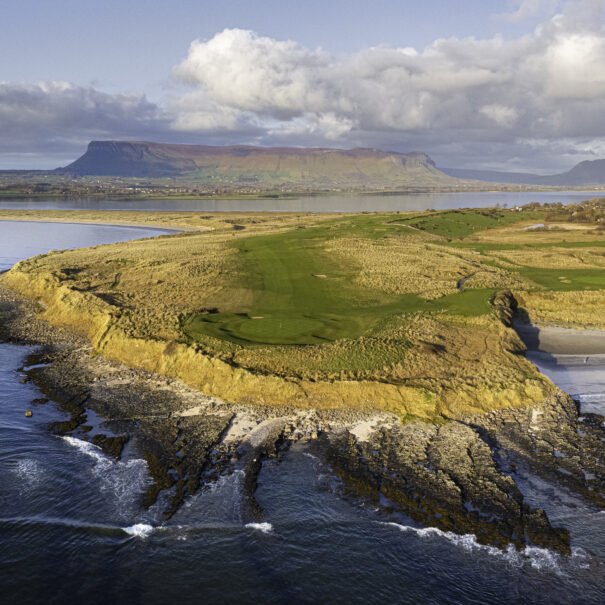
Photograph: County Sligo Golf Club (Rosses Point)
There is a vantage point on the third tee at County Sligo Golf Club where, on a clear day, you can see five counties at once. The Atlantic is to the west, the Ox Mountains to the south, and rising flat-topped above the bay to the north is Ben Bulben — the mountain that gave W.B. Yeats his most famous opening line: "Under bare Ben Bulben's head, in Drumcliffe churchyard Yeats is laid." The poet's grave is six miles up the coast, in the shadow of the same mountain you stare at from the third tee.
Yeats spent the summers of his childhood at Rosses Point. The light, the bay, the line of the mountains — they shaped a body of work that runs to thirty volumes and won him the 1923 Nobel Prize in Literature. They also, less famously, sit behind one of the great championship links in Ireland.
At a Glance
Course: County Sligo Golf Club (Rosses Point), Co. Sligo
Type: Links
Founded / opened: Founded 1894; second nine added 1907
Main architects: George Combe (original nine, 1894); Harry Colt (1927 redesign)
Par / back tee yardage: Par 71; plays to more than 6,800 yards from the back tees, depending on setup
Best paired with: Carne and Enniscrone on a Northwest leg
Practical note: Walking only; an exposed bayside links where the wind is the constant; around 45 minutes from Knock Airport.
The Course: Combe, Campbell, and the Hand of Harry Colt
The club was founded in 1894 by Colonel James Campbell, Arthur Jackson, and Harper Campbell Perry — three men with a connection to the local British military regiment and a taste for golf. The first nine holes were laid out by George Combe, then the secretary of the Golfing Union of Ireland, and opened the following year. The second nine was added in 1907 by Captain Willie Campbell, the Colonel's stepbrother.
The course we play today is largely the work of Harry Shapland Colt, who was brought in from 1927. By that point, Colt was among the most respected golf architects in the world. Some architecture writers place County Sligo among Colt’s most compelling works, alongside courses such as Wentworth, the New Course at Sunningdale, and Moor Park West.
The West of Ireland Amateur Championship has been closely associated with Rosses Point since 1923 and is one of Irish amateur golf’s great annual fixtures.
The Signature Holes
The 3rd: The drive at the 3rd is the moment the trip locks in. From the elevated tee box the entire bay opens up — Ben Bulben to the north, Knocknarea (the burial cairn of Maeve, Queen of Connacht, in legend) to the south, and the line of the Atlantic stretching west toward Donegal. Yeats wrote about this view repeatedly. The shot itself is a downhill drive into a generous fairway, but few players manage to address the ball without taking a moment first.
The 4th — Henry Cotton's favourite: A par-3 that Sir Henry Cotton called among the finest in the world. The hole drops down toward the strand, played to a green defended by a deep cross-bunker and the bay beyond. In a crosswind it is one of the hardest short holes in Ireland; on a calm summer evening, with the light coming low across the water, it is one of the most beautiful.
The 12th — out to land's end: A long par-5 that tumbles out toward the very edge of the peninsula, ending almost in the sea. The hole is downwind from the helping prevailing breeze on most days, but the second shot still has to flirt with sand to the left and a sliver of fairway that narrows as it approaches the green.
The closing stretch — Tom Watson's verdict: Tom Watson, an eight-time Open champion, has called the run from the 14th to the 18th at Rosses Point one of the best finishing stretches in golf. Five demanding holes through Colt's most natural duneland, with the bay tightening to your left and the wind almost always in your face. There is no easy par on the way home.
The County Sligo Experience
The clubhouse at Rosses Point is small, plain, and very Irish — a polished bar, honours boards listing the West of Ireland champions back to the 1920s, and a window that looks out at the strand. The membership is welcoming to visitors in a way that some of the more famous Irish links have lost. You will leave with a recommendation for where to eat dinner and where to hear traditional music, and the recommendation will be correct.
The course is walking-only and the terrain is honest — gentle rolls rather than vertical dunes — but the wind off the bay is the constant. This is one of the more weather-dependent links in Ireland: a still day at Rosses Point makes the course look generous, and a windy one will leave you with no easy shots at all.
Caddies here are local, and many will tell you about Yeats and the bay before they tell you about the line off the third tee. They are not wrong to.
Getting There and What's Nearby
Sligo town is forty-five minutes from Knock Airport and roughly two-and-a-half hours from Dublin. Rosses Point itself is a small seaside village ten minutes north of Sligo, and the area around it is the most concentrated stretch of Yeats heritage in Ireland.
The obvious half-day excursion is Drumcliffe, six miles up the coast, where the poet is buried in the churchyard he wrote about: the headstone simply says "Cast a cold eye on life, on death. Horseman, pass by." A short drive further is Mullaghmore, the harbour village where Lord Mountbatten was assassinated in 1979 — a quieter chapter of Irish history, in a beautiful place. For non-golfing partners, the Yeats Memorial Building in Sligo town and the prehistoric tombs at Carrowmore are worth a half-day each.
Why County Sligo Belongs on Your List
Among the great Irish links, County Sligo is the one most often missed by first-time visitors — partly because the northwest is geographically further from the Dublin and Shannon arrival airports, and partly because the marquee names of the southwest and Northern Ireland tend to dominate itineraries. That is a shame. County Sligo offers a Harry Colt design at the level of his finest English work, in a setting that has inspired some of the greatest poetry written in English, with a closing stretch that has earned the highest praise an Irish course can receive.
For golfers building a longer trip — eight days or more — adding Rosses Point to a Northwest leg alongside Carne, Enniscrone, or Ballyliffin makes for one of the most distinctive itineraries in Irish golf. For shorter trips, County Sligo is the course that rewards the detour.
County Sligo features in Argyle Links' Northwest Ireland packages, often paired with Carne and Enniscrone for golfers wanting to discover the quieter side of Irish links. We arrange tee-time requests, coordinate accommodation in Sligo or Rosses Point, and arrange chauffeured transfers from Knock or Dublin Airports. Start planning.