
Waterville Golf Links: The Course at the End of the Road and the Statue That Watches Over It
Reading time: 5 minutes
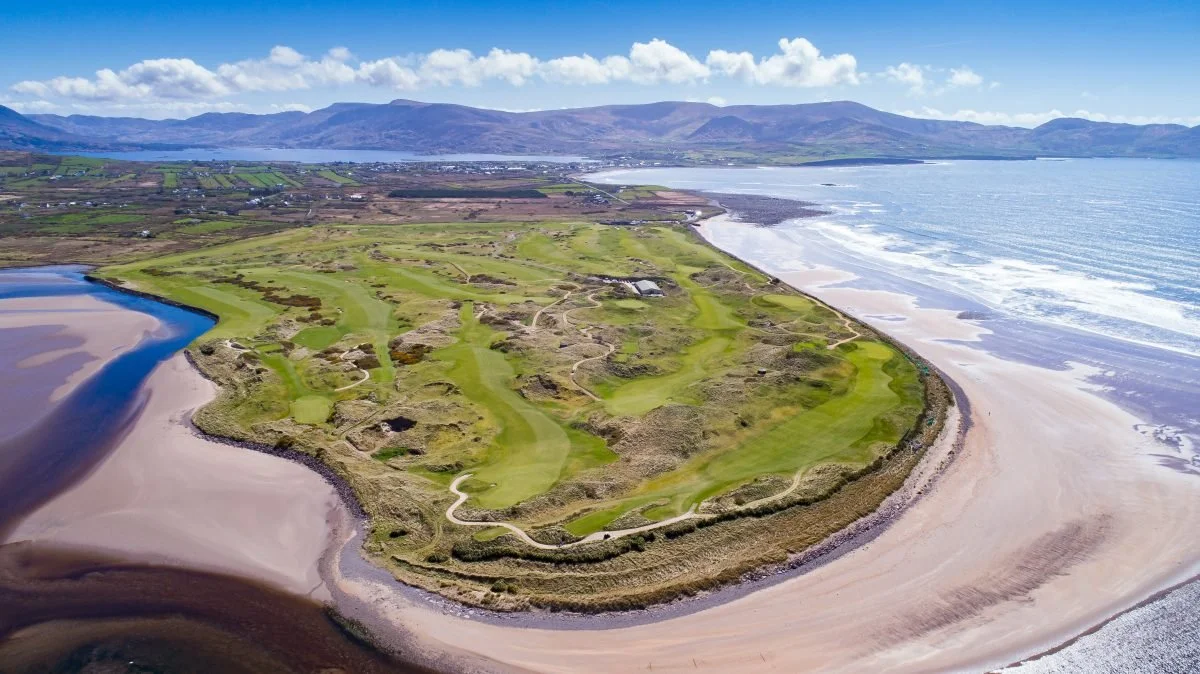
Photograph: Waterville Golf Links.
At the western edge of the Ring of Kerry, where the road runs out at Ballinskelligs Bay and the Atlantic stretches uninterrupted toward Newfoundland, there is a bronze statue of an American golfer in plus-fours holding the trophy from his 1999 U.S. Open win. The man is Payne Stewart, and he was meant to be the Honorary Captain of Waterville Golf Links the year after that photograph. He never got there. His Learjet lost cabin pressure over South Dakota on 25 October 1999, and he died at forty-two.
The statue was unveiled at Waterville not as a memorial to a tragedy but as a thank-you. In the year before his death, Stewart had fallen for the place, the course, the village, the people, and accepted the honorary Captaincy of Waterville Golf Links shortly before he died. The statue stands by the first tee, looking out at the holes he never played as Captain. Visitors stop to read the plaque and then walk past it to begin their own round.
That is Waterville in microcosm: a course that has earned a depth of feeling among the people who play it that few others quite match.
At a Glance
Course: Waterville Golf Links, Co. Kerry
Type: Links
Founded / opened: Golf at Waterville since 1889; modern 18-hole links opened 1973
Main architects: Eddie Hackett with Claude Harmon (1973); later refined by Tom Fazio (c. 2000)
Par / back tee yardage: Par 72; can stretch to more than 7,300 yards from the back tees, depending on setup
Best paired with: Killarney, Tralee and Ballybunion on a Southwest Kerry week
Practical note: Remote Ring of Kerry setting; walking only; roughly 1h30 from a Killarney base. Tee times best requested after 09:30.
The Course: Mulcahy, Hackett, and a Plot of Land at the End of the Road
There has been golf at Waterville since 1889, when a nine-hole course was laid out under the local athletic club. By the 1950s it was derelict. The course was rescued in 1968 by John A. "Jay" Mulcahy, an Irish-American businessman who bought the land along with an enormous tract of adjoining duneland and decided to build, in his own words, the most testing championship links in the world.
He hired Eddie Hackett, Ireland's foremost links architect, to lay out the course. He brought in Claude Harmon, the 1948 Masters champion and the long-serving head professional at Winged Foot, as a consultant. The modern championship links opened in 1973 and can now stretch to more than 7,300 yards from the back tees, depending on setup.
Around the millennium, the club commissioned Tom Fazio to refine Hackett's work. Fazio relocated several greens, recontoured a few of the flatter putting surfaces, and built two new holes, a par-3 sixth and a par-4 seventh, to give the front nine the same dunes-driven character as the back. The result is a course that feels seamless, even though it was built across three decades by three of the great names in golf architecture.
The Signature Holes
The 12th, "The Mass Hole": A 200-yard par-3 played across a deep, protected valley to a green sitting up among the dunes. The story is among the best in Irish golf. Local tradition holds that when the course was being built, the workers refused to lay the green at the bottom of the valley because local people had used that hollow to celebrate Catholic Mass in secret during the Penal Laws, when doing so was punishable by death. An agreement was reached: the green was lifted up into the dunes above, and the ground below was left untouched. You play across it.
The 17th, "Mulcahy's Peak": A 194-yard par-3 played from a tee box high in the dunes, the highest point on the course, named after Jay Mulcahy, who chose the spot personally. From the tee, the entire links unfolds beneath you, the bay stretches west, and the wind is rarely doing what you think it is. The view alone is worth the round.
The 18th, "O'Gradys Beach": A long par-5 along the Atlantic shoreline, with the beach running parallel to the entire fairway. A demanding finishing hole on a calm day, and an unforgettable one when the wind is up. The walk down the eighteenth at Waterville, with the sea on your right and the clubhouse coming into view, is among the most evocative in Ireland.
The 1st, "Last Easy": The opening hole carries the most honest name in Irish golf. The first is the gentlest hole on the course. Everything that follows asks more of you. You will not get an easier shot than your opening drive.
The Waterville Experience
Waterville the village is small, a single main street, a row of pubs, a harbour where small fishing boats still go out for crab, and the clubhouse sits at the end of it, looking across the bay to the Skelligs. Charlie Chaplin spent ten consecutive summers here with his family in the 1960s and 70s; a statue of him stands in the village square, and the bar at the Butler Arms Hotel still has photographs of him on the walls. The Skellig Islands, where two of the most recent Star Wars films were shot, are visible from several holes on the course.
The caddies at Waterville are local, and many have been on the bag for thirty years or more. They know the wind off the bay, they know which run-up shots will catch the slope into a green, and they will tell you the Mass Hole story without prompting because it is the story they want every visitor to take home.
The course is walking-only. The terrain is more demanding than it looks, the dunes are tall, the walks between some greens and tees are long, and the wind off the Atlantic will sap energy you did not know you were spending.
Getting There and What's Nearby
Waterville sits about an hour-and-a-half from Kerry Airport and roughly the same from Killarney. The Ring of Kerry drive on the way in is one of the most photographed coast roads in Europe, and a rest day in this part of the country gives access to the Skellig Islands (boat trips run weather-permitting from Portmagee), the Gap of Dunloe, and the lakes of Killarney National Park.
The village itself is a quiet base for a few nights. The Butler Arms and Smugglers Inn are both within walking distance of the course; the local seafood is excellent and the chowder is among the best in Kerry.
Why Waterville Belongs on Your List
Waterville is sometimes called the most remote of the great Irish links, which is true and also part of the point. The drive out is a small commitment of time, and the course rewards it with a depth of character that the more accessible names cannot quite match. There is the Mass Hole, the Stewart statue, the long walk down the eighteenth with the Atlantic on your right. There is the sense, walking off the green in the late afternoon, that you have played somewhere genuinely apart from the world.
Among golfers who have played the full Irish marquee circuit, Waterville often emerges as the favourite of the southwest, not because it is the longest test or the most photographed, but because it carries a feeling the others cannot replicate.
Planning Your Visit to Waterville
Waterville sits at the end of the Ring of Kerry, about an hour and a half from Killarney, so the day is built around the drive.
Tee times: because of the drive from most Kerry bases, tee times are best requested from mid-morning, after 09:30, rather than early.
Book well ahead: Waterville is a sought-after links, so reserve your dates in advance.
Proof of handicap: bring proof of an official handicap; the club can ask to see it.
Caddies: local caddies know the wind and the lines and are well worth taking; request one ahead.
Walking only: the round is on foot and takes around four and a half hours.
Green fees: Waterville sits among the higher green fees in the South West, in keeping with its reputation.
We arrange tee-time requests at Waterville and build the Ring of Kerry day around the drive.
Waterville is a cornerstone of Argyle Links' Kerry and Southwest Ireland packages. We arrange tee-time requests, coordinate accommodation in the village or at nearby Killarney properties, and arrange chauffeured transfers along the Ring of Kerry. Contact us today to secure your tee-times.