
Ballybunion Old Course: The Cliffside Links That Made Tom Watson Fall in Love and Bill Clinton Bring 10,000 People
Reading time: 5 minutes
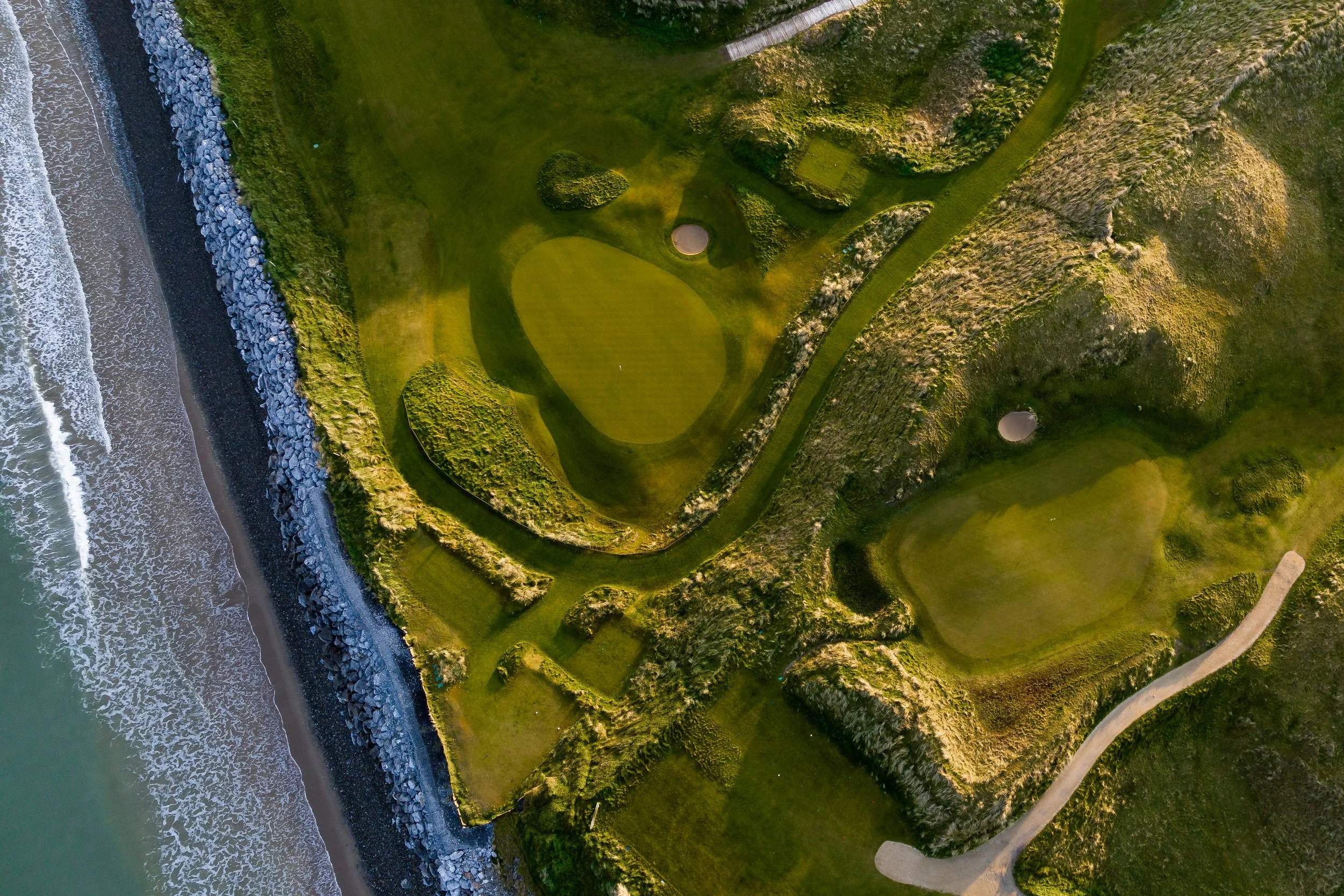
Image courtesy of Ballybunion Golf Club, used with permission.
On the 5th of September 1998, the sitting President of the United States stood on the 1st tee at Ballybunion Golf Club in Co. Kerry and tried to keep a tee shot out of a cemetery. An estimated ten thousand people had turned out to watch him try. Bill Clinton was in Ireland for the closing rounds of the Northern Ireland peace process, and he had wanted, before he flew home, to play one round at the course he would later name as his favourite in the world. He aimed his drive well left of the cemetery wall that runs the length of the 1st fairway's right side. The wind took it, as the wind at Ballybunion will, and carried the ball across the wall and well beyond it. The crowd, which had assembled along ropes from the clubhouse to the third green, was delighted.
That round, and the small ceremony around it, was the most public moment in Ballybunion's history. It was not, however, the moment that made the course's reputation. That had happened almost thirty years earlier, in a quiet conversation between the club manager and a visiting American writer who would, in print, describe what he had seen as "nothing less than the finest seaside course I have ever seen."
At a Glance
Course: Ballybunion Golf Club (Old Course), Co. Kerry
Type: Links
Founded / opened: Club founded 1893; expanded to 18 holes by 1927
Main architects: Tom Simpson (1937 refinements); Tom Watson (1995 bunker and green refresh)
Par / back tee yardage: Par 71; plays to more than 6,800 yards from the back tees, depending on setup
Best paired with: Tralee, Lahinch and Waterville on a Southwest week
Practical note: North Kerry, on the Shannon estuary; walking only; about 1h15 from Shannon Airport.
The Course: Founded 1893, Refined by Tom Simpson, Loved by Tom Watson
Ballybunion Golf Club was founded in 1893 on land at the mouth of the Shannon estuary, on Kerry's north coast. For its first three decades it was a modest nine-hole club used principally by local players. In 1927, the course was expanded to a full eighteen holes laid out across the dunes that rise sharply behind the strand. In that form, with minor adjustments, the Old Course took on roughly its present routing.
In 1937, in preparation for hosting the Irish Men's Close Championship for the first time, the club appointed Tom Simpson — by then one of the most respected golf architects in the British Isles — to recommend changes. Simpson, on arrival, was so taken by what nature had already done at Ballybunion that he recommended only three major changes: a re-siting of the 7th and 13th holes, and the addition of a mid-fairway bunker on what is now the 1st. His report, preserved in the club's archive, described the land as having "terrain that surpasses any course we know for beauty, not excepting Pine Valley." It was the closing line of his architect's brief, and a more concise endorsement of Ballybunion's natural quality has not been written since.
The course was a closely held Irish secret for the next thirty years. It was the American golf writer Herbert Warren Wind — author of the long, considered pieces on golf in The New Yorker through the post-war decades — who first put Ballybunion on the international map. Wind visited at the start of the 1970s and told the club manager, Sean Walsh, that Ballybunion was "nothing less than the finest seaside course I have ever seen." His subsequent essay was the moment that Ballybunion entered the international conversation, and it has never left.
Tom Watson first played the Old Course in 1981, in the company of his friend Sandy Tatum, then president of the United States Golf Association. Watson was, by that point, already a five-time major champion and a man with considered opinions about every great links in the British Isles. He fell for Ballybunion immediately. He returned year after year, played it in every conceivable wind, and in 1995, after winning five Open Championships on Scottish links, he agreed to perform what the club describes as a "labour of love": a sympathetic refresh of the bunkering and the green surrounds across the Old Course. Watson's brief was, characteristically, to do as little as possible — to refine the lines, not to redesign them. He kept faith with Simpson's principle, and the Old Course remains today recognisably the same routing that Simpson had blessed in 1937.
The Signature Holes
The 1st — "Cemetery": The opening hole is a 392-yard par-4 with the village cemetery enclosed by a stone wall running the entire length of the right side. The wall is in play. The cemetery is genuinely in play. President Clinton's opening tee shot found it. So have many others. The first tee at Ballybunion is one of the few in world golf where the most important shot of the round is the one that gets you walking, not the one that gets you scoring.
The 7th — "Cliffside": A par-4 played hard along the edge of the cliffs above the Atlantic. The right side falls away to the beach a hundred and fifty feet below. Tom Simpson's 1937 re-siting moved the green further into the cliff edge than its original position, and the result is one of the great cliff-edge par-4s in links golf.
The 11th — "Watsons": A 472-yard par-4 with the entire right side falling off the cliff. The green sits in a natural amphitheatre of dunes with the Atlantic as a backdrop. It is the hole most often cited, by the players who know the course, as the single finest at Ballybunion — and one of the finest par-4s in world golf. The club renamed it in Watson's honour in recognition of his long association with the course. To play it in a calm evening, with the tide low and the light coming off the water, is to understand why Watson kept coming back.
The 17th and 18th: A short par-5 and a stout par-4 to close, both played back through the highest section of the duneland. The 17th green sits in a punchbowl that gathers anything middle-of-fairway; the 18th plays back towards the clubhouse with the round either rescued or lost on its final approach.
The Cashen Course: Robert Trent Jones Sr's Other Side
In 1985, the club opened a second eighteen — the Cashen Course — designed by the American architect Robert Trent Jones Sr. Jones was seventy-nine years old when he routed it. He took the land to the south of the Old Course, working in higher and more chaotic dunes, and produced something quite different in character: bolder shapes, more vertical movement, larger greens, and a stronger sense of the architect's hand on the land. Opinion among visitors divides on whether the Cashen is the equal of the Old or the lesser of two unequal twins; what is not in dispute is that to play both in one day is one of the great links experiences in Ireland.
Getting There and What's Nearby
Ballybunion sits on Kerry's north coast, an hour and a quarter from Shannon Airport and two hours from Kerry Airport. It pairs naturally with Tralee (an hour south) and Lahinch (an hour and a half north, via the Killimer–Tarbert car ferry across the Shannon estuary). For a Southwest week, Ballybunion is the north Kerry anchor of the great Atlantic links circuit — naturally pairing with Lahinch and Doonbeg to the north, and Tralee, Waterville and Dooks to the south.
The village itself is small, friendly, and entirely shaped around the golf club. Accommodation runs from the historic Cashen Course Hotel through to country house options inland; for a major trip, most visitors stay in nearby Listowel or further south in Killarney and drive in. The Listowel Writers' Week each May (the longest-running literary festival in Ireland) and the Lartigue Monorail Museum offer non-golfing diversions; the Cliffs of Moher are a Shannon-ferry-and-an-hour to the north on a rest day.
Why Ballybunion Belongs at the Top of Your List
Ballybunion is, by a clear margin, the course most frequently cited as the favourite by the architects and players who have played every great links in the British Isles. Tom Watson said so for forty years. Herbert Warren Wind said so in print. Bill Clinton said so to the assembled press in 1998. The list of professional opinion that places Ballybunion in the top tier of world links is unusually long and unusually consistent.
For a Southwest trip — and increasingly for any first Irish trip — Ballybunion is the round that defines the week. It is the course the rest of the itinerary is built around, and it is the round that, in the years after the trip, the group will keep returning to in conversation. Few links in the world deliver as completely on the second visit as on the first; Ballybunion is one of them.
Planning Your Visit to Ballybunion
The Old Course welcomes visitors most days, and a little planning secures the morning light on the cliffs.
Book well ahead: Ballybunion is one of the South West's most sought-after links, so reserve your dates well in advance, mornings especially.
Proof of handicap: bring proof of an official handicap; marquee links can ask to see it on the day.
Caddies: a caddie reads the cliffs and the wind better than any rangefinder; request one ahead of time.
Walking only: the round is on foot through the estuary dunes and takes around four and a half hours.
Green fees: Ballybunion sits among the higher green fees in the South West, in keeping with its standing.
We arrange tee-time requests at Ballybunion and shape the South West week around it.
Argyle Links builds Southwest itineraries around Ballybunion — typically a four-, seven-, or ten-day trip linking the Old Course with Tralee, Lahinch, Waterville, Doonbeg, and Adare Manor. We arrange tee-time requests, coordinate accommodation in Listowel, Killarney, or Kenmare, and arrange chauffeured transfers including the Shannon estuary ferry. Contact us today to secure your tee-times.