
How to Plan a Sensible Week of Irish Links Golf: A Step-by-Step Guide to the Trip That Looks Easy on a Map
Reading time: 7 minutes
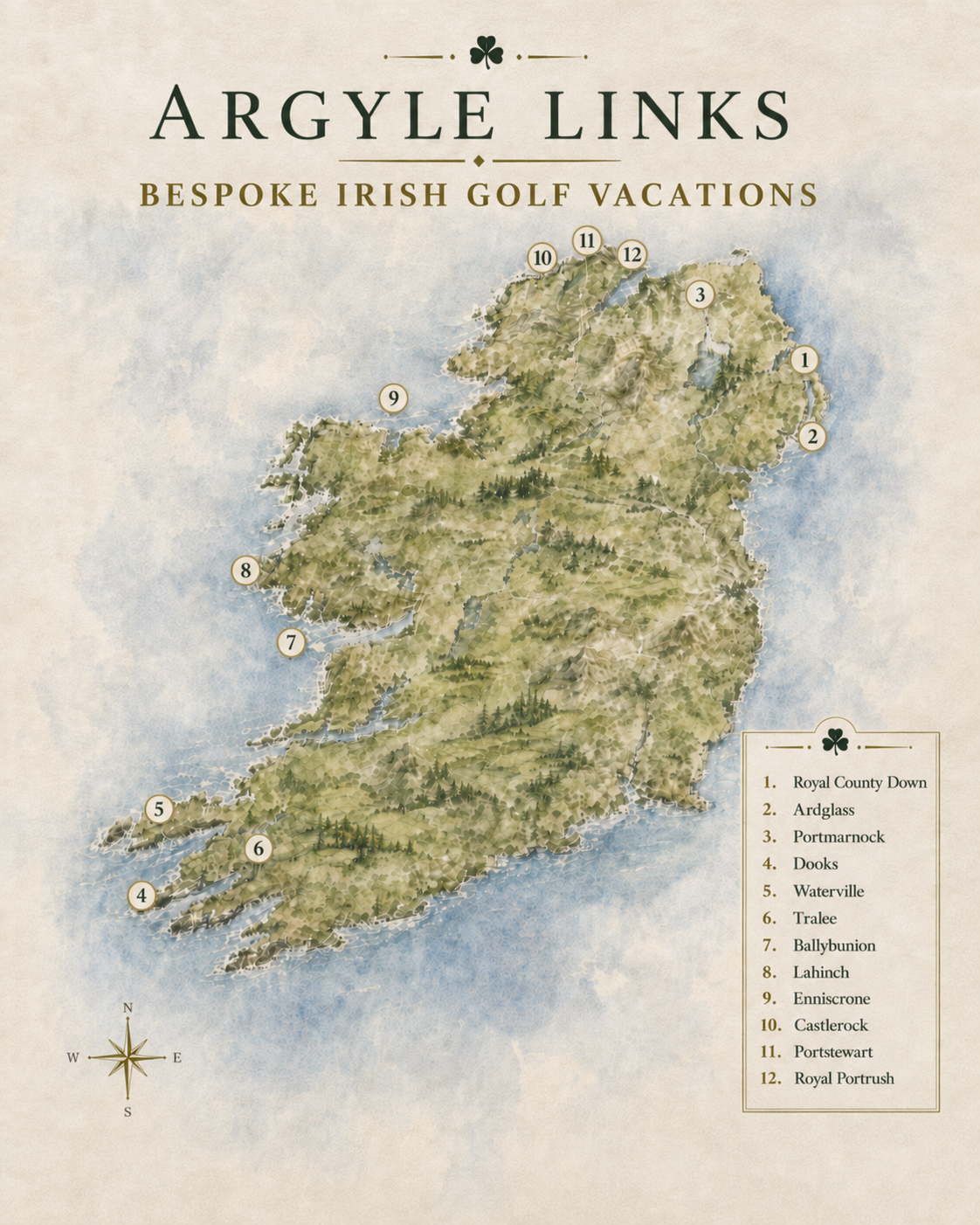
A first-time visitor looking at a map of Ireland will, almost without exception, conclude that planning a week of links golf is going to be easy. The island is small. The courses are well-known. There are a handful of obvious bases — Dublin, Killarney, Newcastle, Portrush — and a manageable number of marquee names. Six or seven days, six rounds, one car. Booked in a long weekend on the laptop. How hard can it be?
The honest answer is that the trip is possible to plan yourself, and many international visitors do exactly that. The other honest answer is that a sensibly planned trip — one that arrives at the right airport for the route, takes the right ferry at the right hour, uses the right base for each region, lands the right tee times in the right order — involves a long sequence of small decisions, each of which has knock-on effects. This piece walks through the order in which those decisions should be made.
Step 1: Decide What Kind of Trip You're Actually Booking
Three answers are common, and each leads to a different itinerary. The course-focused trip is built around playing the most highly ranked Irish courses in a single week. It typically crosses the island once and delivers four to six championship rounds. The region-focused trip picks one of Ireland's four distinct links regions — Causeway Coast, Co. Down, the east, or the southwest — and plays everything of consequence within it over five to seven days from a single base. The mixed trip combines a region with one or two marquee venues from elsewhere. Most visitors actually want the mixed trip; it is also the trip that requires the most thoughtful sequencing.
The single most expensive mistake in trip planning is failing to ask this question first. A course-focused traveller who books a region-focused itinerary spends two days driving past the courses they came for. A region-focused traveller who books a course-focused itinerary spends three days more on the road than they wanted.
Step 2: Pick the Airport, Then the Season
Ireland has five international airports of consequence for golf travel: Dublin (DUB), Shannon (SNN), Cork (ORK), Belfast International (BFS), and Belfast City (BHD). Kerry (KIR) is a smaller regional option useful only for the deep southwest. The right airport is not the cheapest direct flight from home; it is the one that puts the rental car at the start of the first day's drive, not the end of a three-hour transfer. The working rule: Northern Ireland trip flies Belfast; Co. Down trip flies Belfast or Dublin (DUB to Newcastle is 90 minutes); east-coast trip flies Dublin; southwest trip flies Shannon; an all-Ireland trip lands at one airport and departs from another.
The season decision is downstream. May, June, and September are the best months — long daylight, manageable wind, shoulder-season pricing in May and September. July and August are the warmest but also the most expensive and the most booked. April and October are excellent value but daylight is shorter. The Adare Manor Ryder Cup in September 2027 will compress accommodation availability across the southwest for that month and the months either side; trips for autumn 2027 need to be booked in 2026.
Step 3: Build the Regional Spine and the Drive Times
The four regional clusters are the spine of any sensible itinerary. Within each cluster, courses are within an hour's drive of one another. Between clusters, the drive is two to four hours — a travel day, not a between-round drive.
Causeway Coast (NI north): Royal Portrush, Portstewart, Castlerock. Base: Portrush or Bushmills. Belfast-Portrush 1hr 15min.
Co. Down (NI east): Royal County Down, Ardglass. Base: Newcastle. Belfast-Newcastle 50min; Dublin-Newcastle 1hr 45min.
East coast (Republic): Portmarnock, Royal Dublin, The European Club. Base: Dublin or the coastal villages just north. Dublin-Portmarnock 30min.
Southwest (Kerry, Clare, Limerick): Lahinch, Doonbeg, Ballybunion, Tralee, Waterville, Adare Manor. Base: Lahinch for the northern half, Killarney or Kenmare for the southern half. Shannon-Lahinch 1hr 15; Shannon-Killarney 1hr 45.
The Shannon estuary is the critical piece of southwest geography. The road from Lahinch to Ballybunion via Limerick is 2hr 30; via the Killimer-Tarbert car ferry it is 1hr 40 including the 20-minute crossing. The ferry runs every 30 minutes between 9am and 6pm from May to October, every hour outside those times. The ferry should be booked online before travel, every leg.
Step 4: Lock the Tee Times in the Right Order
Marquee Irish clubs operate visitor tee sheets that open at fixed lead times. Royal County Down, Royal Portrush, and Lahinch open 12-18 months in advance, and the peak slots — Friday and Saturday mornings in July and August — are typically gone within an hour of opening. Portmarnock opens 6-12 months ahead. Ballybunion, Tralee, and Waterville are less constrained than the absolute marquee names but summer weekends still book out months ahead. Adare Manor is constrained year-round and increasingly so as the 2027 Ryder Cup approaches.
The sequencing matters. The marquee rounds anchor the week and should be booked first, in order of constraint: Royal County Down and Royal Portrush first; Lahinch next; Ballybunion and Tralee after that; supporting courses last. A common error is booking the supporting courses first and then finding the marquee tee times only available on inconvenient days.
Step 5: The Driving Day-By-Day
Three working rules keep the trip pleasant rather than punishing. One round per day — a championship links round walked with a caddie is genuinely enough golf for a day. No round and a four-hour drive in the same day — the round day is the round day; the travel day is the travel day. Build in one rest day mid-week — it doubles as your weather buffer.
Step 6: Accommodation Strategy
Single base works for Co. Down (Newcastle), the east (Dublin), and the Causeway Coast (Bushmills or Portrush). It does not work for the southwest — distances are too long for one base.
Rotating bases is the answer for the southwest: Lahinch for the northern half, then Killarney or Kenmare for the southern half, moving every two or three nights. Logistics are tighter; the morning drive to the course is shorter on every round day.
Heritage and castle properties — Ashford Castle, Dromoland Castle, Adare Manor, Mount Juliet — are themselves part of the trip and worth anchoring the itinerary around. They book out earliest and should be confirmed first.
Step 7: The Non-Golfer Companion
Half of trip parties include a non-golfing partner. The itinerary that succeeds for both members is the one planned with the non-golfer as a first-class consideration from the start. The accommodation has to work for the non-golfer as well as the golfer — a clubhouse-adjacent hotel chosen for its 50-yard walk to the first tee is not a hotel anyone wants to be alone in for six hours. The Causeway Coast offers the Giant's Causeway, Bushmills Distillery, and the Carrick-a-Rede rope bridge. Co. Down offers Castle Ward (Game of Thrones' Winterfell) and the Mourne Mountains. The southwest offers the Cliffs of Moher, the Ring of Kerry, the Dingle Peninsula, and Killarney National Park. The non-golfer's day should be researched and pre-booked with the same care as the round.
Step 9: Build in Contingency
Three things go wrong on most trips. A flight delay extends the first day's travel and compresses the first round. A weather day closes a course or makes the round meaningfully unpleasant. A health issue sidelines one player. The itinerary needs to absorb each without breaking. Fly in the day before the first round, not the morning of. Keep the rest day flexible enough to swap with any round day if the weather window suggests it. Understand the cancellation policy on every booking before you sign — most Irish marquee clubs have no refunds.
Step 10: The Booking Sequence and Timing
The booking sequence should begin 18 months in advance. Marquee tee times first. Heritage hotels second. Flights third. Supporting tee times fourth. Restaurants in heritage villages from six months out. Ferry tickets a month in advance.
The Honest Closing Note
Every step above is something the engaged traveller can do for themselves. The marquee club websites are well-built. The ferry timetables are online. The hotels take direct bookings. Many travellers do exactly this and produce trips that work.
The other honest thing to say is that doing it all yourself is the equivalent of taking on a full time job for the three months before travel, and that the small mistakes — the wrong tee time on the wrong day, the ferry sailing missed, the supporting course booked on a day the marquee anchor cannot be played — are the kind of mistakes that take days off the trip rather than minutes off the schedule. The value of having someone else do this work is the certainty that, when you arrive at the first tee, the round in front of you is the only thing you have to think about.
Argyle Links plans Irish golf trips end to end — we hold tee times at the marquee clubs, coordinate accommodation across heritage hotels and championship resorts, and arrange chauffeured transfers between airports and courses. Start planning.