
Ardglass Golf Club: The World’s Oldest Clubhouse, a Norman Harbour, and the Cliffside Round Half an Hour from Royal County Down
Reading time: 5 minutes
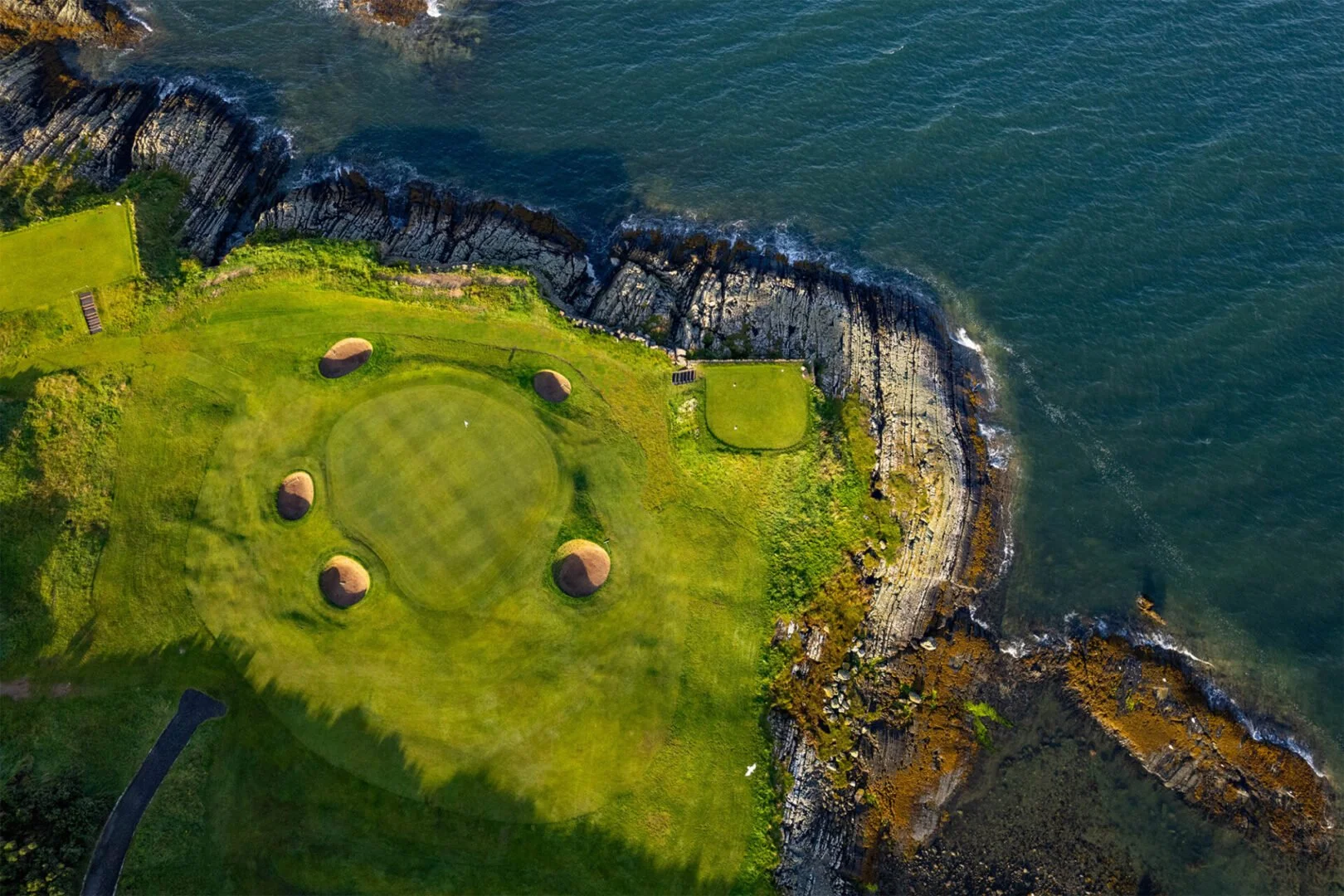
Image courtesy of Ardglass Golf Club, used with permission.
On a small headland on the County Down coast, where the Irish Sea meets the eastern edge of Lecale, there is a medieval keep with a golf flag flying above it. The building has been there since at least 1405. It was put up as a fortified merchant's warehouse, what the Normans called a mercantile castle, to protect the goods being landed at Ardglass harbour from the raiders who worked the Irish Sea in the late Middle Ages. It became a family home in the eighteenth century, picked up an elegant Georgian extension in 1788, and then in 1896, when a local Church of Ireland minister called Thomas MacAfee persuaded a small group of his parishioners that the headland would make a fine place for a golf course, the building became a clubhouse. It is widely claimed as the oldest building in the world used as a golf clubhouse, and on that reckoning the world's oldest clubhouse is not in St Andrews or Prestwick or North Berwick. It is in a fishing village in Co. Down, around 35 to 45 minutes from Royal County Down depending on routing, and most international visitors have never heard of it.
This is a piece about why Ardglass Golf Club is the round that should be added to every Northern Ireland trip after Royal County Down, Royal Portrush, and Portstewart, and why, on the days when those three are fully booked, it is the round you should put first.
At a Glance
Course: Ardglass Golf Club, Co. Down
Type: Links
Founded / opened: Club founded 1896; clubhouse building dates to at least 1405
Main architects: Rev. Thomas MacAfee (original); David Jones (three Coney Island holes, 1998); Ken Kearney (2018)
Par / back tee yardage: Par 70; plays to more than 6,200 yards from the medal tees, depending on setup
Best paired with: Royal County Down on a Co. Down itinerary
Practical note: Best experienced on foot; widely claimed as the world's oldest golf clubhouse; around 35 to 45 minutes from Royal County Down. Saturdays are reserved for members until early afternoon, so visitor tee times are arranged accordingly.
The Clubhouse: 1405, Probably Earlier
The story properly begins with a Norman knight called Sir John De Courcy, who landed at Ardglass harbour in 1177 as part of the Anglo-Norman invasion of Ulster. The harbour was already in use as a trading port at that point, which means the present clubhouse, first documented in 1405 but constructed on demonstrably older footings, may sit on stonework that pre-dates the Norman conquest entirely. The building has been continuously occupied for at least six hundred and twenty years and possibly closer to nine hundred. It has been a customs warehouse, a defensive keep, a family residence with eighteenth-century extensions, and, for the last hundred and twenty-eight years, the place where the members of Ardglass Golf Club have their post-round pint.
The architectural fact is worth registering on its own terms. There are, in the world of golf, perhaps half a dozen clubhouses with claims to extraordinary age. North Berwick's clubhouse, much loved, dates from 1894. Royal Liverpool's from 1895. The R&A's clubhouse at St Andrews opened in 1854. Ardglass pre-dates all of them by four to five centuries. There is no other clubhouse on earth where you can hand your card to the secretary in a room with arrow-slits cut into the wall.
The Course: Reverend MacAfee, David Jones, and 130 Years of Quiet Expansion
The course itself has had a slower-burn history than the building. The Reverend MacAfee's 1896 layout was seven holes totalling under a thousand yards, shoehorned, in the club's own phrase, into the small piece of ground where the present 1st and 18th fairways sit. In 1907, the club leased additional land along the cliffs and expanded to nine holes. That nine-hole layout, with minor adjustments, remained essentially unchanged for the next sixty years. Ardglass was, for most of the twentieth century, a small members' club known to a few hundred local golfers and rarely visited from outside the region.
In the late 1960s, the club purchased further land along the headland and laid out its first 18-hole routing. The most consequential modern change came in 1998, when David Jones, a former European Tour professional turned course architect, designed three new holes on additional land overlooking Coney Island Bay. The new holes pushed the course further along the cliff edge and added the dramatic carries over the Irish Sea that now define the front nine. In 2018, the Irish architect Ken Kearney undertook further refinements. The current Ardglass plays as a par-70 over 6,216 yards from the medal tees, short by modern championship standards, but with the wind and the cliff carries it has never been a course where length is the principal challenge.
The Signature Holes
The 2nd, "Howd's Hole": A 167-yard par-3 played from a clifftop tee, across a rocky sea inlet, to a narrow green that hangs over the next stretch of coast. The carry is total, there is nothing between the tee and the green except sea, rock, and surf. In any wind from the east the shot becomes one of the most demanding short-iron tests in Irish golf. The hole is, in the opinion of many visitors, the best par-3 in Co. Down, and that is saying something, given Royal County Down is around 35 to 45 minutes up the coast.
The first five holes: The opening stretch runs along the cliff tops with the Irish Sea to the left, the wind almost always present, and the views across to the Isle of Man and the Mountains of Mourne behind. It is the most distinctive opening five in Northern Ireland golf, and the round's character is set by the time the player walks off the 5th green.
The 11th and 12th, the Coney Island stretch: The par-5 11th and the par-3 12th are the two David Jones holes from 1998 that make the back nine. Both require carries across the coastline; both reward the player who has read the wind correctly and punish the one who has not. The 12th in particular plays across a sea-edge ravine to a small green and has become, alongside the 2nd, the photograph that defines the course in the marketing literature.
The closing stretch: The round finishes back at the medieval clubhouse, with the last two holes climbing slightly towards the keep. The 18th green sits within sight of the clubhouse's arrow-slits, and the walk from green to bar is the shortest in Irish golf.
The Ardglass Experience
Ardglass is a working members' club, not a destination resort. The membership is welcoming to visitors, the green fee is a fraction of Royal County Down's, and the round is best experienced on foot. The bar serves a proper Guinness and a generally excellent fish chowder, Ardglass harbour is one of the busiest fishing ports in Northern Ireland, and the harbour setting gives the clubhouse food and the village restaurants a strong local seafood character. The members' room, with its sea-facing windows cut through walls a metre thick, is one of the more atmospheric spaces in Irish golf.
The course is generally regarded as the best of the lesser-known links on the eastern Co. Down coast, and increasingly as one of the more rewarding day-trip additions to a Northern Ireland itinerary. Today's Golfer and National Club Golfer both rank Ardglass within the top thirty courses in Ireland; the membership would probably argue it should be higher.
Getting There and What's Nearby
Ardglass sits on the easternmost edge of the Co. Down coast, around 35 to 45 minutes from Royal County Down at Newcastle, and roughly an hour from Belfast City Airport and closer to 75 minutes from Belfast International, traffic dependent. The village itself is a working fishing harbour with a handful of seafood restaurants and a single pub of consequence; most visitors stay either at the Slieve Donard in Newcastle (where the Royal County Down clubhouse is visible from the front rooms) or at one of the country house options between Strangford and Downpatrick.
The surrounding Lecale Peninsula is one of the more historically dense corners of Ireland: St Patrick's burial site at Down Cathedral is fifteen minutes' drive away, Castle Ward (the National Trust property used as Winterfell in Game of Thrones) is twenty minutes north, and the Mourne Mountains rise on the horizon for almost every hole of the round. For a Northern Ireland trip with a rest day built in, the Lecale loop is the most rewarding non-golf drive in the region.
Why Ardglass Belongs on Your Northern Ireland List
For a long Northern Ireland trip, five days or more, Ardglass is the round that turns a Royal County Down and Causeway Coast itinerary into something more interesting than a tick-list of championship venues. The course is genuinely good. The medieval clubhouse is genuinely unique. The fish chowder is genuinely excellent. And the round is one of the few in Northern Ireland where, on a calm Tuesday afternoon, you can still find an unhurried tee time and play through in three and a half hours.
For a shorter trip, three days or fewer, Ardglass is the round you book when Royal County Down's visitor tee sheet has closed for the week and you want a Co. Down links experience that is, in its own way, no compromise at all. There are courses in Ireland with longer pedigrees in the international rankings, but very few of them are more memorable to actually play.
Argyle Links includes Ardglass in our Co. Down packages alongside Royal County Down, and as a value-day option on Northern Ireland itineraries that begin or end in Belfast. We arrange tee-time requests, coordinate accommodation at the Slieve Donard or Lecale country houses, and arrange transfers from Belfast and Dublin Airports. Start planning.