
Portstewart Golf Club: The Schoolteacher Who Redesigned a Championship Links and Tubber Patrick’s First Tee
Reading time: 5 minutes
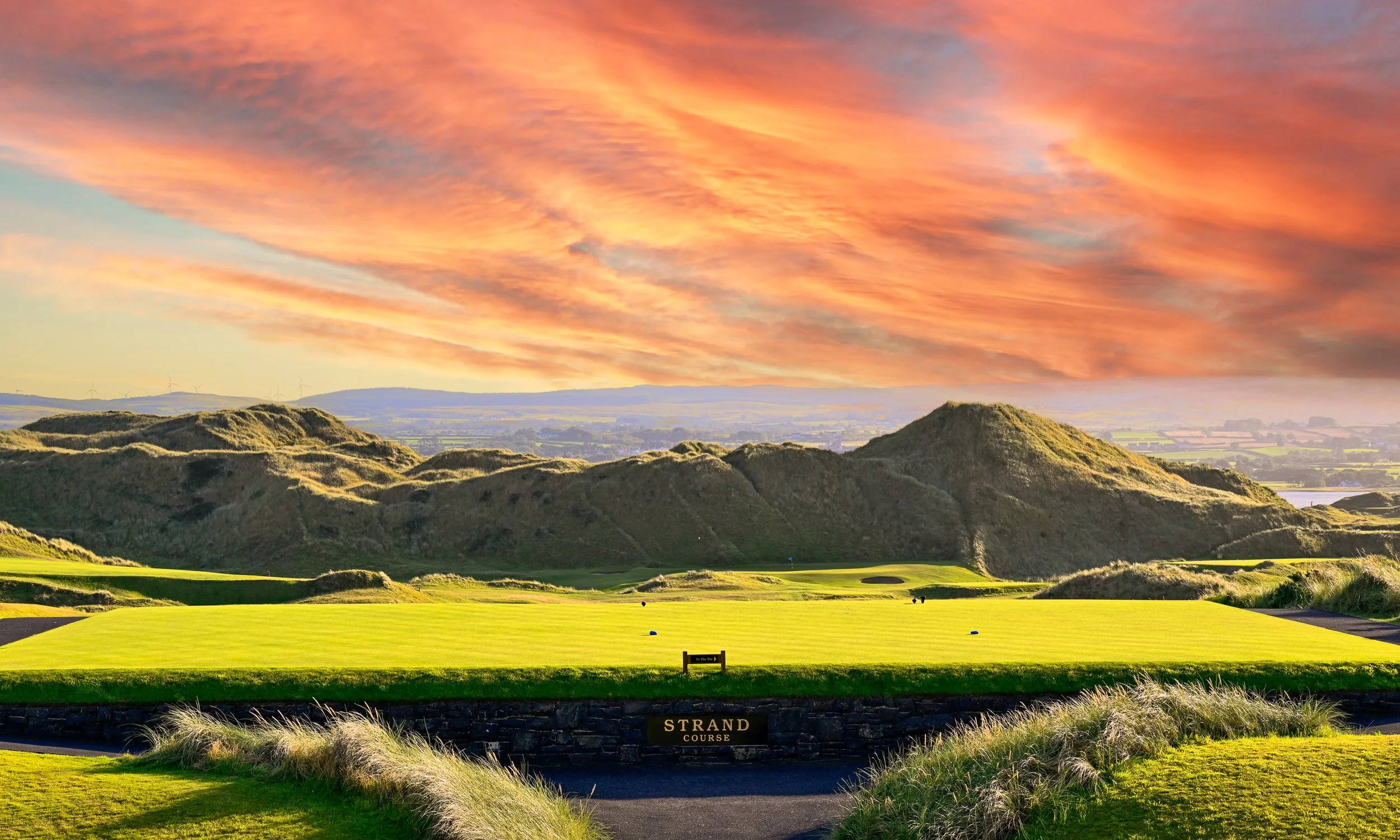
Image courtesy of Portstewart Golf Club, used with permission.
If you stand on the first tee at the Strand Course at Portstewart on a clear morning, the view runs from the Atlantic and the Inishowen Peninsula across to your left, the white-sand strand of Portstewart town curving away to your right, and a fairway dropping a hundred feet below you into an amphitheatre of dunes. The hole is called Tubber Patrick, named, the local story goes, for a well on the nuns' walk above the course where St Patrick once stopped to drink. It is widely considered the finest opening hole in Irish golf, and it is also the moment most visitors stop pretending they came here just for a casual round.
What is less widely known is that the seven holes you walk through after Tubber Patrick, holes 2 through 8, the most spectacular dune-strewn sequence on the course, were designed by a local schoolteacher named Des Giffin. He had never designed a golf course in his life.
At a Glance
Course: Portstewart Golf Club (Strand Course), Co. Londonderry
Type: Links
Founded / opened: Club founded 1894; Strand Course opened 1908
Main architects: A.G. Gow (1908); Willie Park Jr. (1920); Des Giffin (Thistly Hollow holes 2-8, 1992)
Par / back tee yardage: A championship links stretching to more than 7,000 yards from the back tees, depending on setup
Best paired with: Royal Portrush and Castlerock on the Causeway Coast
Practical note: Walking only; a dramatic dune-driven front nine; around 10 minutes from Royal Portrush. Some weekday members' time windows apply, so visitor tee times are arranged around them.
The Course: From A.G. Gow to a Schoolteacher's Masterpiece
Portstewart Golf Club was founded in 1894. The original Strand Course opened for play in July 1908, laid out by A.G. Gow, the professional at neighbouring Royal Portrush, after the club hired him in March 1907. In 1920, Willie Park Jr., the two-time Open Champion and one of the most celebrated golf architects of his era, redesigned the course into the rough shape it carries today.
For most of the twentieth century, the Strand was a strong links, but its routing kept it on the flatter ground above the dunes, where the most dramatic terrain on the property went unused. In the late 1980s, the club bought a stretch of virgin duneland known locally as Thistly Hollow. The question of who would design the seven new holes through it was contentious. The eventual answer was Des Giffin, a member of the club and a local schoolteacher with a deep knowledge of the dunes and no professional architectural credentials. The new course opened in 1992. Holes 2 through 8 are entirely his work, and the 6th has since been renamed in his honour.
His design has held up to scrutiny most professionals would envy. In July 2017, the European Tour brought the Dubai Duty Free Irish Open to Portstewart for the first time in the club's history. Crowds of more than 92,000 spread across the week, and the young Spaniard Jon Rahm won the tournament with a record score of 24-under-par. In the final round he holed a 7-iron from 196 yards for eagle on the par-5 fourth, one of Giffin's holes, and a brass plaque now marks the exact spot from where the shot was struck.
The Signature Holes
The 1st, "Tubber Patrick": 425 yards, par-4, played from a tee that sits roughly a hundred feet above the fairway. The shot is a dogleg right into a corridor of dunes; in any wind, the right-hand line is dangerous and the left-hand line is too long. It is not an unfair opening tee shot, but it is one of the most intimidating in Ireland until you know the line. Even on a calm morning, most first-time visitors take a moment on the tee box before they reach for the driver.
The 4th, site of Rahm's eagle: A par-5 through the deepest part of the Thistly Hollow duneland. The drive must find a fairway between two dunes; the second shot rewards a high, soft approach to a green tucked into a natural amphitheatre. Rahm's 7-iron from 196 yards was, by his own description, the shot of his career to that point. The plaque is set into the turf about ten yards from where his ball came to rest.
The 6th, "Des Giffin": Named for the architect who designed it. A short par-4 through dunes that rise on both sides, played to a green protected by sand and a slope that rejects anything weak. A hole that is more interesting at 350 yards than most courses' showpiece par-4s at 470.
The closing stretch along the Bann: The back nine eases away from the high duneland and runs along the broad banks of the River Bann, a different kind of golf, more open, with a cooler wind. The contrast between the dune-driven front nine and the riverside back nine is part of what makes Portstewart so distinctive among Irish links.
The Portstewart Experience
The clubhouse sits at the top of the dunes, looking down at Portstewart town and out at the Atlantic. The bar is informal, the welcome is warm, and the membership is unusually proud of the course, partly because of the 2017 Irish Open, but more because Des Giffin's holes prove that a local schoolteacher with the right eye can build links holes the equal of anywhere in Ireland.
The course is walking-only. The terrain on the front nine is genuinely demanding, Thistly Hollow's dunes are taller than they look, and the wind off the Atlantic is rarely absent. A caddie is the right call, and the ones at Portstewart know which lines bring the dunes into play and which routes around them keep the round honest.
Getting There and What's Nearby
Portstewart sits on the Causeway Coast in Northern Ireland, less than ten minutes from Royal Portrush, twenty minutes from the Giant's Causeway, and around 60 to 75 minutes from Belfast International Airport, depending on traffic. The two courses are commonly played together over a single day or back-to-back days, they are close to each other in geography, character, and quality.
For a non-golfing day, the Causeway Coast offers the Giant's Causeway itself (a UNESCO World Heritage Site of basalt columns formed by ancient volcanic activity), the Carrick-a-Rede rope bridge, and the ruins of Dunluce Castle perched dramatically above the sea. The Old Bushmills Distillery, the world's oldest licensed whiskey distillery, granted its licence by King James I in 1608, is a short drive inland.
Why Portstewart Belongs on Your List
For a long time, Portstewart was the championship Irish links most often left off itineraries, the smaller name across the headland from Royal Portrush. The 2017 Irish Open changed that. Visitors who play the Strand now consistently come away saying it deserved its place on the European Tour calendar, and Des Giffin's holes through Thistly Hollow are routinely cited among the best dune-driven sequences in Northern Ireland.
For a Causeway Coast itinerary that already includes Royal Portrush, Portstewart is the natural second round of the trip. For golfers who have played both, Portstewart is often the surprise, the course they did not expect to rate as highly as Portrush, and frequently do.
Portstewart features regularly in Argyle Links' Northern Ireland packages, paired with Royal Portrush and the Causeway Coast hotels. We arrange tee-time requests, coordinate accommodation on the Causeway Coast, and arrange chauffeured transfers from Belfast or Derry Airports. Start planning.