
Portmarnock Golf Club: Dublin’s Championship Links and Ireland’s Quietest Giant
Reading time: 5 minutes
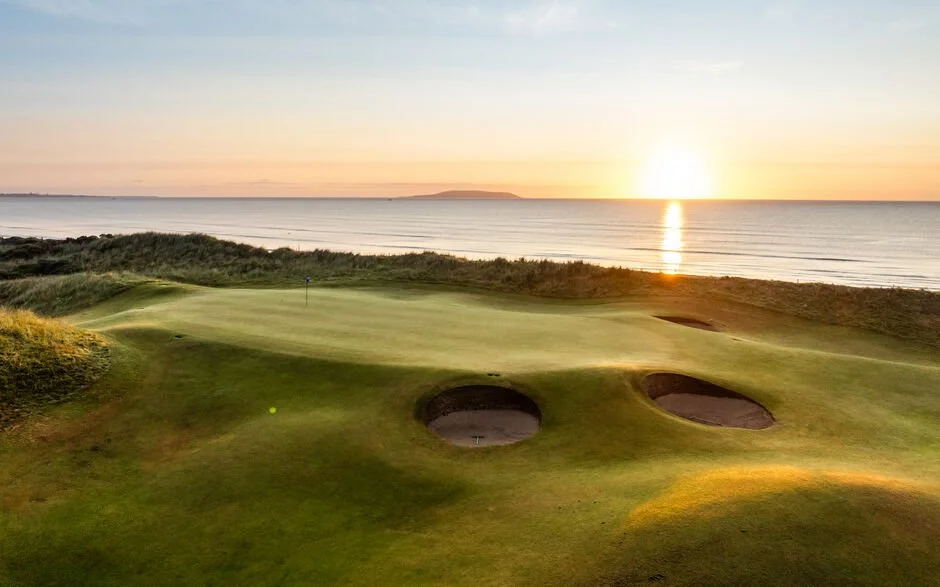
There is a peninsula on the north Dublin coast where two insurance men, William Pickeman and George Ross, made a boat trip from the mainland in 1893 to assess a strip of sandhills they had heard about. They came back convinced. The following year, with the help of John Jameson of the whiskey family, they founded Portmarnock Golf Club. Mungo Park, the 1874 Open Champion, was brought over to supervise the original design and stayed on as the club's first professional.
That is more or less the start. What followed is the championship history of Irish golf in one place: 19 stagings of the Irish Open, a Walker Cup, a Canada Cup, two Amateur Championships, and a roll of honour that lists most of the great names in the sport. For a course with no ocean cliffs, no signature island green, and no dune-lined drama visible from the car park, Portmarnock is a remarkable thing. It is also one of the quietest great courses in the world about its credentials.
At a Glance
Course: Portmarnock Golf Club (Championship Links), Co. Dublin
Type: Links
Founded / opened: Founded 1894; full 18 opened 1896
Main architects: Mungo Park and W.C. Pickeman (original); Fred Hawtree (third nine, 1972) and Martin Hawtree (later refinements)
Par / back tee yardage: Par 72; plays to more than 7,400 yards from the championship tees, depending on setup
Best paired with: Jameson Golf Links and an east-coast / Dublin leg
Practical note: The historic members' championship links, a separate course from Jameson Golf Links at the Portmarnock Resort nearby. Walking only; around 15 to 20 minutes from Dublin Airport.
The Course: A Peninsula That Decides How It Wants to Be Walked
Portmarnock sits on a narrow peninsula bordered by sea on three sides, which is the central fact about the course. Most championship links run out and back along a single shoreline; Portmarnock cannot, because the peninsula bends. The routing turns on itself repeatedly, which means the wind is rarely in the same direction for more than three holes at a stretch. On a stiff day you will use every club in the bag.
The original 18 holes were laid out by Pickeman with Mungo Park's input, opening fully in 1896. Fred Hawtree added a third nine in 1972, and his son Martin made further refinements before the 2003 Irish Open, lengthening the championship card to more than 7,400 yards. The land has barely needed reinventing in 130 years. It is, essentially, the peninsula telling you how it wants to be walked.
The Signature Holes
The 14th, Henry Cotton's favourite: Sir Henry Cotton, three-time Open Champion, called this the best par-4 in the world. The drive plays to a generous fairway, but the second shot is where the hole earns its reputation, a long-iron or hybrid into a green that sits exposed above the estuary, with sand ready to punish anything weak on the approach side. Joe Carr famously holed his second shot for an albatross-eagle here. For the rest of us, a four in any wind is a quiet victory.
The 15th, the par-3 along the sea: Just under 200 yards from the back tee, played along the shoreline with the Irish Sea to the right. Arnold Palmer called it the best short hole in the world. Ben Crenshaw, after winning the 1976 Irish Open here, was less reverent: he called the 15th "the shortest par-5 I've ever played", a backhanded tribute to a hole on which the wind, the bunkering, and the small green conspire to make even the easiest yardage feel impossible.
The 5th: A mid-iron par-3 across a shallow valley to a green defended by revetted bunkers. Less famous than the 15th but in a crosswind it is just as hard, and on a calm day it is one of the prettiest short holes you will play in Ireland.
The closing stretch: Bernard Darwin, the dean of British golf writing, said Portmarnock's last five holes were unmatched anywhere in the game. Two long par-4s, a demanding par-5, and the stern walk home to a clubhouse that has been watching its members come up the eighteenth for more than a century.
The Portmarnock Experience
The clubhouse is old-world and unpretentious, polished wood, honours boards running the length of two walls, and a bar that has been serving golfers since the Victorian era. There is none of the theme-park feel that creeps into some modern championship venues. You come to Portmarnock to play golf, not to be entertained about the playing of golf.
Caddies here are a particular breed. Many are former competitive players themselves, and the best of them have looped for major champions in their day. They read the wind off the estuary better than any app, and a round with a Portmarnock caddie is as close as most visitors get to a one-on-one tutorial on how to play Irish links.
The course is walking-only. The terrain is gentle by Irish links standards, no vertical dune climbs, no blind shots over hills, but the length and the wind will still leave you honestly tired by the eighteenth.
Getting There and What's Nearby
Portmarnock sits around 15 to 20 minutes from Dublin Airport and roughly 30 to 40 minutes from the city centre, traffic dependent, which makes it the most logistically convenient championship links in Ireland. Many visitors open or close a trip here, a round on arrival day if the body holds up, or a final round before the flight home.
The village of Malahide is five minutes away and worth an evening for its medieval castle, its harbour restaurants, and a handful of the best pubs in north Dublin. If you have a rest day in the city, the combination of Trinity College, the Book of Kells, and an evening in Temple Bar is the obvious trio. A quieter alternative is the Howth Head cliff walk, fifteen minutes up the coast, which offers the best view of Dublin from the sea.
Why Portmarnock Belongs on Your List
There is a particular kind of golfer who leaves Portmarnock as their favourite round of the trip. It is usually the player who values shot-making over spectacle, the one who would rather a demanding par-4 into the breeze than a blind shot over a dune. The course asks the same questions the greatest championship venues in the world ask, and it asks them without theatre.
It is the Irish links course that most resembles what championship golf looked like a hundred years ago, and it has not needed to change. For a first-time visitor to Ireland building an itinerary around the marquee names, Portmarnock is the course that teaches you the most about how links golf is supposed to be played.
Planning Your Visit to Portmarnock
Portmarnock welcomes visitors and sits 15 to 20 minutes from Dublin Airport, which makes it a natural opening or closing round.
Book well ahead: as one of Ireland's championship links it is in steady demand, so reserve your dates in advance, mornings especially.
Proof of handicap: bring proof of an official handicap; the club can ask to see it on the day.
Caddies: experienced caddies are available and read the wind on the exposed peninsula well; request one ahead.
Walking only: the round is on foot along the peninsula and takes around four and a half hours.
Green fees: Portmarnock sits among the higher green fees near Dublin, in keeping with its championship pedigree.
We arrange tee-time requests at Portmarnock and chauffeured transfers straight from Dublin Airport.
Portmarnock is a cornerstone of Argyle Links' Dublin and east coast packages, and a natural opening or closing round on any Ireland trip. We arrange tee-time requests, coordinate accommodation at nearby heritage properties, and arrange chauffeured transfers from Dublin Airport. Contact us today to secure your tee-times.