
A Week on the Wild Atlantic: Why Ireland’s Southwest Links Coast Deserves a Trip of Its Own
Reading time: 7 minutes
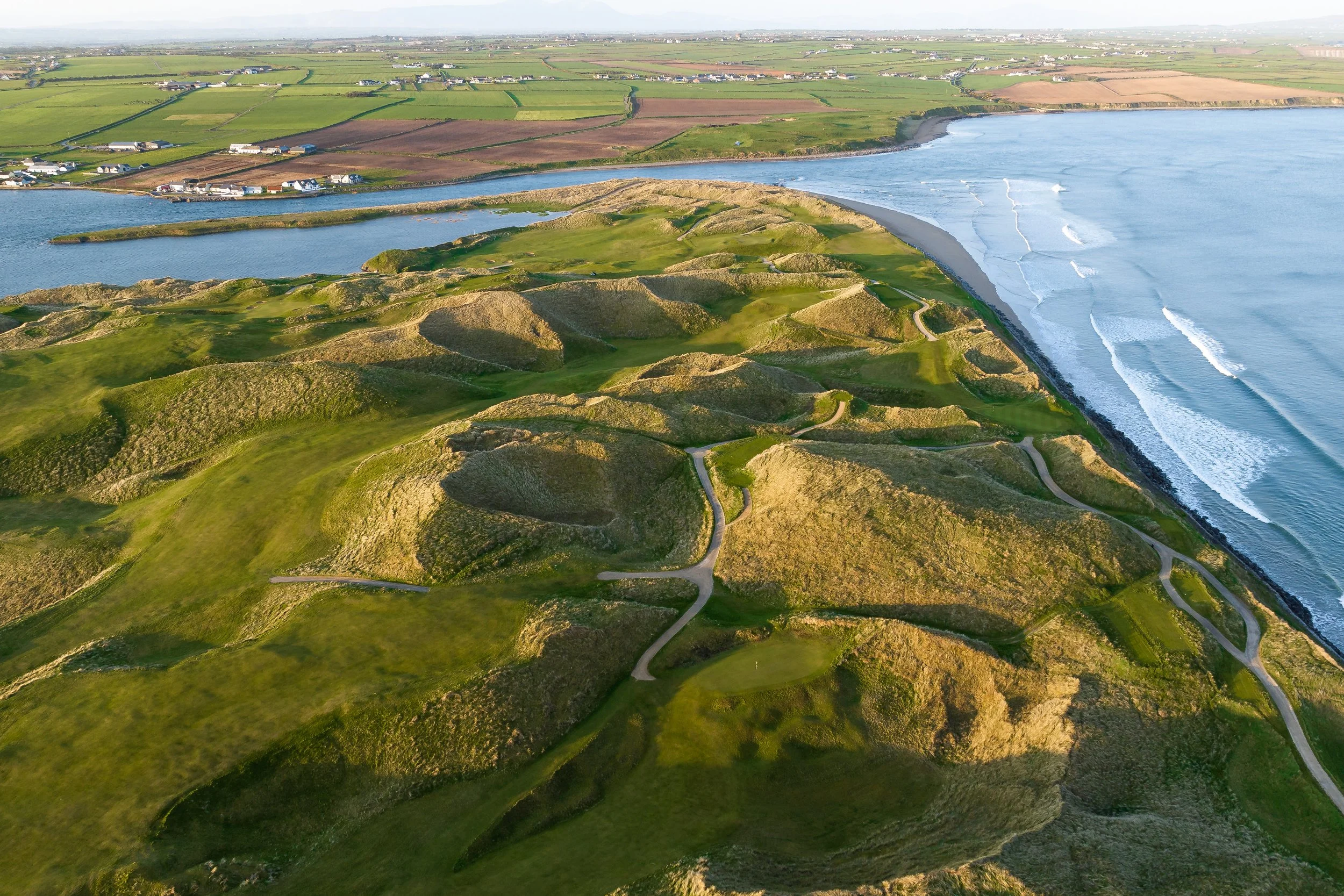
Ireland's southwest is the most extensive and varied stretch of links golf in the world outside of Scotland's east coast — and, by a noticeable margin, it is the most underrated. From Ballybunion north through Lahinch and west out to Waterville, the coast holds five world-ranked links, two of Ireland's most respected parkland tests, two hundred miles of Atlantic shoreline, and a hundred and thirty years of accumulated architecture from Old Tom Morris to Tom Fazio. This is a piece about what is actually down there, why it has tended to be under-discussed in the international conversation, and why a week on the southwest links coast deserves to be planned as a trip in its own right.
Why "Underrated" Is the Right Word
Three things conspire to keep the Southwest under-discussed in the international conversation. The first is rankings methodology. Most major golf rankings rate single courses, not regions. Royal County Down, magnificent and singular, will out-rank any one Southwest course on most lists; what those lists do not measure is whether you can play four world-ranked courses across four consecutive days within a ninety-minute drive of each other. The Southwest can. Almost no other region in the world can.
The second is marketing dominance. Northern Ireland has two championship venues — Royal County Down and Royal Portrush — that have been on the Open Championship and Walker Cup circuits for over a century. They get the magazine covers, the major-week coverage, and the pilgrimage traffic. The Southwest's five anchor courses are spread across two hundred miles of coastline and have, with the partial exception of Ballybunion, never been in the regular major-championship rotation. Less coverage means less awareness; less awareness means underrating.
The third is a quirk of Irish golf history. The Southwest's courses were largely built or refined in waves — Old Tom Morris in the 1890s, Eddie Hackett in the 1970s, Arnold Palmer in the 1980s, Alister MacKenzie's revisited work in the 1990s and 2000s — rather than in a single famous Victorian moment. That distributes their "story" across generations and architects, which makes them harder to summarise in the way Royal County Down can be summarised in two words: Old Tom.
Who Built These Courses
The list of architects who have worked on the Southwest's five championship links reads like a syllabus in golf course architecture. Old Tom Morris of St Andrews — the most influential routing designer of the Victorian era — laid out improvements at Lahinch in 1894, including the still-played par-5 Klondyke and the blind par-3 Dell. Alister MacKenzie, who in the same decade was working on Cypress Point and Augusta National, redesigned the rest of Lahinch in 1927 and chose to preserve Old Tom's two blind originals untouched. Eddie Hackett, the most prolific Irish architect of the twentieth century, laid out Waterville in 1973 on land at the very tip of the Iveragh Peninsula. Arnold Palmer designed Tralee in 1984, his first golf course in Europe, with Ed Seay. Tom Fazio refined Waterville for the championship era in 2006. Greg Norman built the links at Doonbeg in 2002, with Martin Hawtree later refining it into its current state.
It is a strange and lucky thing for one region to have. Most great links coasts in the world are the product of one or two architects working in one period. The Southwest is the product of nearly every major architect of the last hundred and thirty years choosing, at some point, to do their best work on its dunes.
The Five Anchors
Ballybunion (Old Course): The course Tom Watson made famous to the American golf public. Founded 1893, on the cliffs above Ballybunion town in Co. Kerry. The seventh runs along the Atlantic; the eleventh — the famous photograph in every Irish golf book — drops into a channel of dunes. Watson, accepting the Claret Jug at Royal Troon in 1982, said: "Nobody can call himself a golfer until he has played at Ballybunion; you would think the game originated there." It is still the truest sentence about the Southwest in print.
Lahinch (Old Course): An hour north of Shannon, on the Clare coast. The course Old Tom Morris improved in 1894 and Alister MacKenzie reshaped in 1927. Two blind holes — Klondyke and Dell — are still on the card exactly as Old Tom drew them, the only championship links in the world where you walk to two tees a day with no idea where the green is. Lahinch hosts the Irish Open at the highest professional level and remains one of the most affordable championship rounds in Ireland for the visiting golfer.
Tralee Golf Links: Arnold Palmer's first European course, opened October 1984. The front nine is a quiet warm-up; the back nine is what Palmer himself called the part "God designed" — cliffs, hidden greens, tee shots aimed at the horizon over the Atlantic. The most photographed back nine in Irish golf, and not by accident.
Waterville Golf Links: The course at the literal end of the road, on the Iveragh Peninsula. Eddie Hackett's 1973 routing, refined by Tom Fazio in 2006. Payne Stewart was honorary captain in 1999 and a bronze of him in his trademark plus-fours stands beside the clubhouse. The quietest of the anchors and, on the right day, the most affecting.
Doonbeg: Greg Norman's 2002 links along Doughmore Bay in Co. Clare. Less storied than the others, more dramatic in a contemporary way; the dunes here are the highest of any Irish links course. Now operated as an international resort.
The Sixth Course (And the Parkland Round)
If a week-long itinerary feels too links-heavy, the Southwest also delivers two of Ireland's most respected parkland rounds. Killarney's Killeen and Mahony's Point courses, on the shores of Lough Leane in Co. Kerry, have hosted Irish Opens and offer a complete change of pace from the Atlantic exposure. Adare Manor — already familiar to anyone planning around 2027 — sits inland in Co. Limerick and was rebuilt by Tom Fazio in 2018 into one of the most sophisticated parkland tests in Europe. A typical Southwest week of five rounds is two links days, a parkland day, then two links days again. It works because the variety is built into the geography.
What the Southwest Has That the Rankings Cannot Capture
The Southwest is the only region in Ireland where a serious week of golf doubles as a serious week of travel. The 2,500-kilometre Wild Atlantic Way runs the entire west coast and connects every one of the courses on this list. The Cliffs of Moher are forty-five minutes from Lahinch. The Ring of Kerry begins and ends within a half-hour of Killarney. Dingle Peninsula's seafood restaurants — McKenna's, the Half Door, Out of the Blue — serve fish landed that morning at the same harbours your taxi passes on the way to the course. The Skellig Islands, where the Star Wars sequels filmed Luke Skywalker's hermitage, are visible on a clear day from the eighth tee at Waterville. None of this is in the golf rankings, and all of it is part of why the trip is what it is.
It is the kind of country that rewards a slow week. The Southwest is rural and peninsular; days run between coastal villages, fishing harbours, and stone-walled boreens, and there is space for an afternoon walk on the Cliffs of Moher or a drive around the Ring of Kerry between rounds without anything feeling rushed. Both members of a travelling pair tend to come home with their own version of the trip.
The Underrated Conclusion
The Southwest is the trip more golfers would book first if more golfers had the geography clearly in their heads. Five world-ranked links, two parkland tests, two hundred miles of Atlantic coastline, a hundred and thirty years of cumulative architecture, a Wild Atlantic Way that runs from Cliffs of Moher to the Skelligs, and a food scene that has quietly become one of the best in Western Europe — all of it strung together on a single peninsular drive. The rankings can keep their methodology. We will keep booking the trip that delivers, day after day, what the rankings can only approximate hole by hole.
Argyle Links specialises in Southwest itineraries — five-, seven-, and ten-day trips through Kerry, Clare, and Limerick built around Ballybunion, Lahinch, Tralee, Waterville, Doonbeg, Killarney, and Adare. We hold tee times, coordinate accommodation in heritage hotels and country estates, arrange chauffeured transfers along the Wild Atlantic Way, and design a non-golfing partner programme to match. Start planning.