
Lahinch Golf Club: Where the Goats Predict the Weather and the Golf Is Legendary
Reading time: 4 minutes
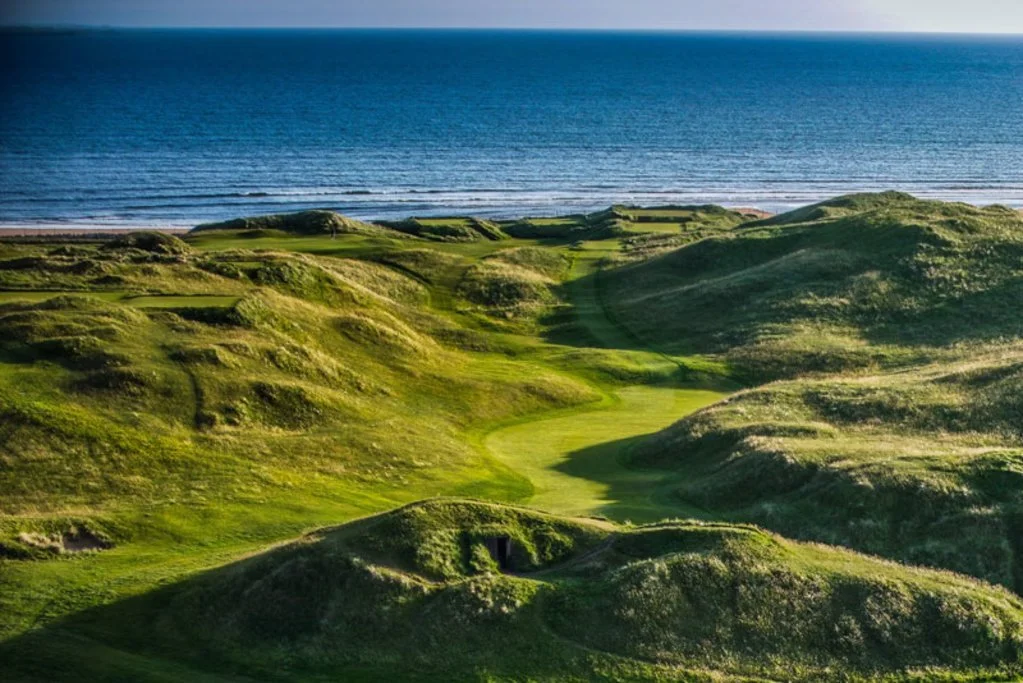
There’s a broken barometer hanging in the clubhouse at Lahinch Golf Club. Or rather, there was. When it stopped working sometime in the 1960s, the club’s secretary, Brud Slattery, didn’t bother fixing it. Instead, he scrawled a handwritten note across the face: “See Goats.”
He wasn’t joking. For over a century, a herd of feral goats has roamed the links at Lahinch, and generations of members have relied on them as weather forecasters. When the goats are grazing out on the dunes, the weather will be fine. When they drift toward the clubhouse, rain is coming. The goats even feature on the club’s official crest, adopted in the 1950s — a nod to a tradition that predates modern meteorology and remains one of Irish golf’s great clubhouse stories.
It’s the kind of story that could only happen at an Irish golf club. And it tells you everything you need to know about Lahinch: this is a place where history, character, and world-class golf exist in equal measure.
At a Glance
Course: Lahinch Golf Club (Old Course), Co. Clare
Type: Links
Founded / opened: Club founded 1892; Old Tom Morris layout 1894
Main architects: Old Tom Morris (1894); Alister MacKenzie (1927 redesign); Martin Hawtree (modernisation)
Par / back tee yardage: Par 72; plays to more than 6,900 yards from the back tees, depending on setup
Best paired with: Dromoland, Doonbeg, Ballybunion and Tralee on a Clare and Kerry week
Practical note: The quirk holes are the 4th (Klondyke) and 5th (Dell); hosted the 2019 Irish Open (Jon Rahm). Walking.
The Course: Old Tom Morris to Alister MacKenzie
Lahinch’s Old Course sits right on the Atlantic coastline in County Clare, exposed to the ocean through all its moods. The first game was played here on Good Friday, 1892, making it one of the oldest courses in Ireland. Old Tom Morris was brought in to develop the layout in 1894 and declared the land among the finest he had ever seen for links golf. Two of his original holes — the famous Klondyke (the 4th) and Dell (the 5th) — survive today, essentially unchanged.
In 1927, Alister MacKenzie — the architect behind Augusta National and Royal Melbourne — redesigned the course and reportedly said that Lahinch would be the finest course he or anyone else had ever constructed. Martin Hawtree later made further refinements around the turn of the 21st century.
The result is a course that blends old and new, tradition and modernity, in a way that feels completely natural. It’s not the longest links you’ll play, and it’s not the most manicured. But it has more personality per hole than almost anywhere else in Ireland.
The Signature Holes
The 4th — “Klondyke”: A par-5 that plays through a valley between towering dunes. Your second shot is completely blind — you aim at a white stone marker atop the dune and hope your ball carries over to the fairway beyond. It’s Old Tom Morris golf at its most authentic, and it’s thrilling every time.
The 5th — “Dell”: The most famous par-3 at Lahinch and one of the most debated holes in Irish golf. The green is entirely hidden behind a massive sand dune, and you play your tee shot to a white marker on the hill. You won’t know how close you are until you walk around the dune and find your ball. Some golfers love it. Some hate it. Nobody forgets it.
The 6th: After the blind drama of 4 and 5, the sixth is a gorgeous, straightforward par-3 that plays with the Atlantic in view. It’s a palate cleanser — and one of the most beautiful short holes on the coast.
The back nine: The inward half is more exposed to the Atlantic wind and plays through broader, more dramatic duneland. The closing stretch, particularly holes 14 through 18, demands concentration and precision — the fairways narrow, the bunkers deepen, and the wind seems to intensify just when you need calm.
The Lahinch Experience
Lahinch the town and Lahinch the course are inseparable. The clubhouse sits at the edge of the village, and the walk from the eighteenth green to the nearest pub is about three minutes. After your round, you can sit in a bar overlooking the beach, watch surfers tackle the Atlantic waves, and process every shot over a pint and a bowl of chowder.
The caddies at Lahinch are characters. They know every bounce, every slope, and every wind trick on the course, and they’ll share it all with you — along with opinions on your swing, your club selection, and life in general. Hiring a caddie here isn’t optional if you want the full experience.
The course is walking-only, and the terrain is more physically demanding than it appears. The dunes are steep, the walks between some greens and tees are long, and the sand beneath your feet adds resistance with every step. It’s a proper workout, and you’ll sleep well after.
The Cliffs of Moher Connection
Lahinch is just fifteen minutes from the Cliffs of Moher, one of Ireland’s most visited natural attractions. The cliffs rise over 700 feet above the Atlantic, and on a clear day, the views stretch to the Aran Islands and beyond. If you have a rest day built into your itinerary — and you should — the Cliffs of Moher are the obvious excursion.
The Burren, a vast landscape of exposed limestone karst that looks like the surface of the moon, is also nearby. It’s one of the most unique geological formations in Europe, and it’s worth a drive even if you only stop for twenty minutes to walk among the rocks.
Why Lahinch Belongs on Your List
Lahinch may not have the global name recognition of Ballybunion or Royal Portrush, but among golfers who’ve played all three, it often emerges as the favorite. It has a warmth and a quirkiness that the more famous courses can’t quite match — the blind shots, the goats, the village setting, the Atlantic crashing just beyond the dunes.
It’s the course that best captures what Irish links golf is really about: a connection to history, a respect for nature, and a refusal to take itself too seriously. Even the goats know when the conditions are right.
Planning Your Visit to Lahinch
Lahinch welcomes visitors to its Old Course, and the blind Klondyke and Dell holes are best met with a little local knowledge.
The course: visitors play the Old Course (the championship links); the Castle Course is a good warm-up.
Book well ahead: Lahinch is one of Clare's most popular links, so reserve your dates in advance, mornings especially.
Proof of handicap: bring proof of an official handicap; the club can ask to see it.
Caddies: a caddie is invaluable on the blind shots at the fourth and fifth; availability is limited, so request one ahead.
Walking only: the round is on foot and takes around four and a half hours.
Green fees: Lahinch sits among the higher green fees in the region, in keeping with its reputation.
We arrange tee-time requests at Lahinch and build the Clare and South West trip around it.
Lahinch is a cornerstone of Argyle Links’ Clare and Southwest Ireland packages. We arrange tee-time requests, coordinate accommodation, and plan scenic routing along the Wild Atlantic Way. Contact us today to secure your tee-times.