
Dromoland Castle Golf Club: Brian Boru’s Country, J.B. Carr’s Redesign, and the Round on the O’Brien Estate
Reading time: 5 minutes
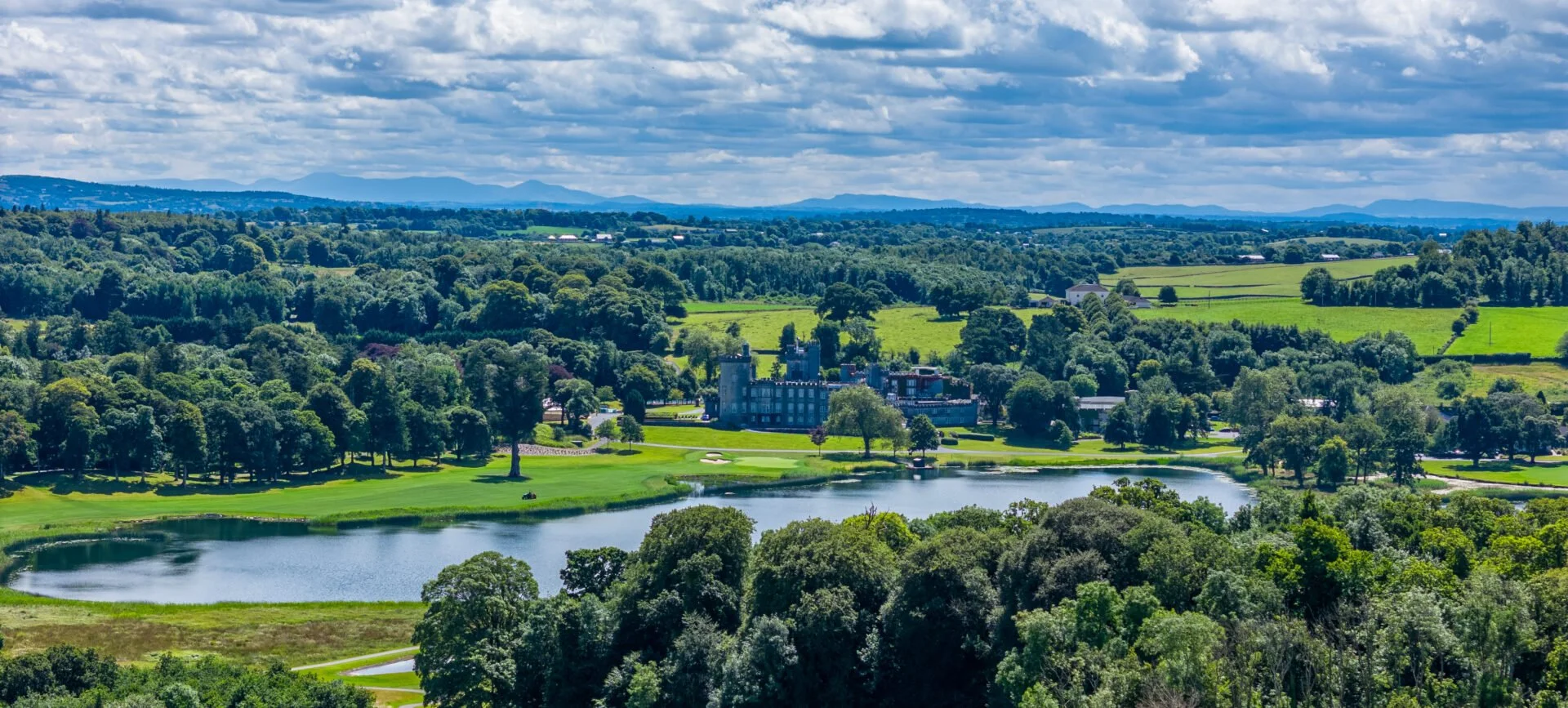
Photograph: Dromoland Castle, Co. Clare.
The estate at Dromoland in County Clare has been continuously occupied by the same family for longer than almost any property in Ireland. The O'Briens, Barons of Inchiquin, holders of one of the oldest noble titles in Europe, trace their line directly to Brian Boru, the eleventh-century High King who died at the Battle of Clontarf in 1014. The current castle, the third on the site, dates to the 1830s. Its parkland, its lakes, and its avenues of beech and sequoia trees have been groomed for two centuries by gardeners who knew that someone would want to walk through it eventually.
That someone, it turned out, was an American industrialist named Bernard P. McDonald, who bought the estate in the 1960s and converted it into a luxury hotel. He commissioned a golf course on the grounds in the early 1960s. Sixty years later, the course has been redesigned twice and hosted the Women's Irish Open on the Ladies European Tour, while the hotel and estate have welcomed two American presidents, a Spanish king, Nelson Mandela, and Muhammad Ali.
At a Glance
Course: Dromoland Castle Golf Club, Co. Clare
Type: Parkland (resort / estate)
Founded / opened: Original course early 1960s; redesigned course reopened 2004
Main architects: Brook L. Wigginton (original); Ron Kirby and J.B. Carr (2003 redesign)
Par / back tee yardage: Par 72; plays to around 6,800 yards from the back tees, depending on setup
Best paired with: Lahinch, Tralee and Ballybunion, as the parkland day on a Southwest week
Practical note: Five-star castle hotel on the estate; buggies available; about 15 minutes from Shannon Airport.
The Course: From Brook Wigginton to Joe Carr
The original course at Dromoland dates to the early 1960s and was designed by the English architect Brook L. Wigginton, a competent parkland layout that took advantage of the estate's mature trees and gentle topography. For its first forty years it served the hotel's guests well without aspiring to championship status.
That changed in 2003. The owners commissioned a comprehensive redesign with two architects working in tandem. The international name was Ron Kirby, an American architect with a deep Irish portfolio. The Irish name was J.B. Carr, the late Joe Carr, the greatest Irish amateur of the twentieth century, three-time British Amateur champion (1953, 1958, 1960), and an eleven-time Walker Cup player. Carr was already in his eighties when the work began and would die in 2004, the year the redesigned course reopened. Dromoland was one of his final projects.
The 2003 work re-routed several holes, introduced new greens and tees, reshaped the bunkering, and most importantly drew the estate's lakes, streams, and mature woodland into deliberate play. The result, opened in April 2004, is a parkland course of around 6,800 yards that is genuinely worthy of its setting.
The Signature Holes
The 7th, the classic par-3: A downhill one-shotter played from an elevated tee through a gap in the mature trees. The green is well-defended; the wind funnels through the trees in unpredictable ways. The hole is widely considered one of the finest par-3s on the West Coast of Ireland and a clear product of Carr's eye for natural-feeling design.
The 11th, around the lake: The par-5 11th is, by general consensus, the best hole on the course. The fairway curves around a substantial lake, with the green peninsula-fashion on the far side. A long hitter can reach in two with a heroic carry over water; the rest of us must lay up, and the second shot demands precision because the third shot is into a green protected by water on three sides.
The 18th, the lake and the sequoia: A 580-yard par-5 finishing hole that has become the visual signature of Dromoland. The drive is generous; the second shot demands a decision, lay up short of the lake or attempt a long carry over the corner. The green, when you finally get there, is guarded by a giant sequoia tree planted on the estate sometime in the nineteenth century. Hitting the green in regulation requires shaping the ball around the tree.
The mature parkland: Throughout the round, the avenue trees, the historic plantings, and the curve of the estate's drive into the castle keep the property's history present. This is parkland golf at its most elegant, a course that feels like it belongs in the grounds of a country house, because it does.
The Dromoland Experience
The hotel itself sits at the centre of the estate, a turreted nineteenth-century castle with two AA Rosettes, a five-star designation, and a guest list that has included two American presidents (George W. Bush during the EU-US Summit of 2004, and Bill Clinton on multiple visits), King Juan Carlos I of Spain, Nelson Mandela, and Muhammad Ali. The interior is heavy with the sense of an Irish ancestral seat, portraits, panelling, deep fireplaces, but the service is contemporary five-star.
For golf groups, the hotel is one of the best-equipped properties in Ireland, full-size driving range, nine practice bays, four bunkered target greens out to 250 metres, dedicated practice green, and chipping area. Buggies are available; the dress code is more formal than at links membership clubs but more relaxed than the most formal European resorts.
Caddies are available on request. The course has more local subtlety than its appearance suggests: the trees deflect winds in unexpected ways, the greens are quicker than they look, and several of the lakes are deeper than they appear from the tee.
Getting There and What's Nearby
Dromoland is a fifteen-minute drive from Shannon Airport, the most logistically convenient five-star resort in Ireland for visitors flying transatlantic. Many trips through the southwest open or close at Dromoland for exactly that reason: a round on arrival day or before the flight home, with no long drive at either end.
For non-golf days, the estate offers falconry (Ireland's School of Falconry is on-site), clay shooting, fishing on the estate lake, and horse-and-trap rides through the grounds. Beyond the estate, the Cliffs of Moher are forty-five minutes away, the Burren is on the doorstep, and Bunratty Castle and Folk Park is fifteen minutes south on the way to Limerick.
Why Dromoland Belongs on Your List
Dromoland is one of the West of Ireland's strongest examples of a golf resort properly integrated with a country-house hotel. For groups travelling with non-golfing partners, families with mixed interests, or visitors who want the comfort of a five-star base for several nights, it is one of the very few Irish properties that delivers both championship golf and country-house accommodation at the same level.
For a golfing itinerary built around Lahinch, Tralee, and Ballybunion, Dromoland makes sense as the parkland round in the middle of the trip, a change of pace, a slightly less weather-dependent day, and a setting that lets non-golfers enjoy themselves equally. For shorter trips, it can be the resort base for the whole week.
Dromoland Castle features regularly in Argyle Links' Southwest Ireland packages, often as the resort base for a multi-night stay paired with rounds at Lahinch, Ballybunion, and Tralee. We arrange tee-time requests, coordinate hotel arrangements, and arrange chauffeured transfers from Shannon Airport. Start planning.