
Royal Portrush: Playing the Course That Crowns Open Champions
Reading time: 4 minutes
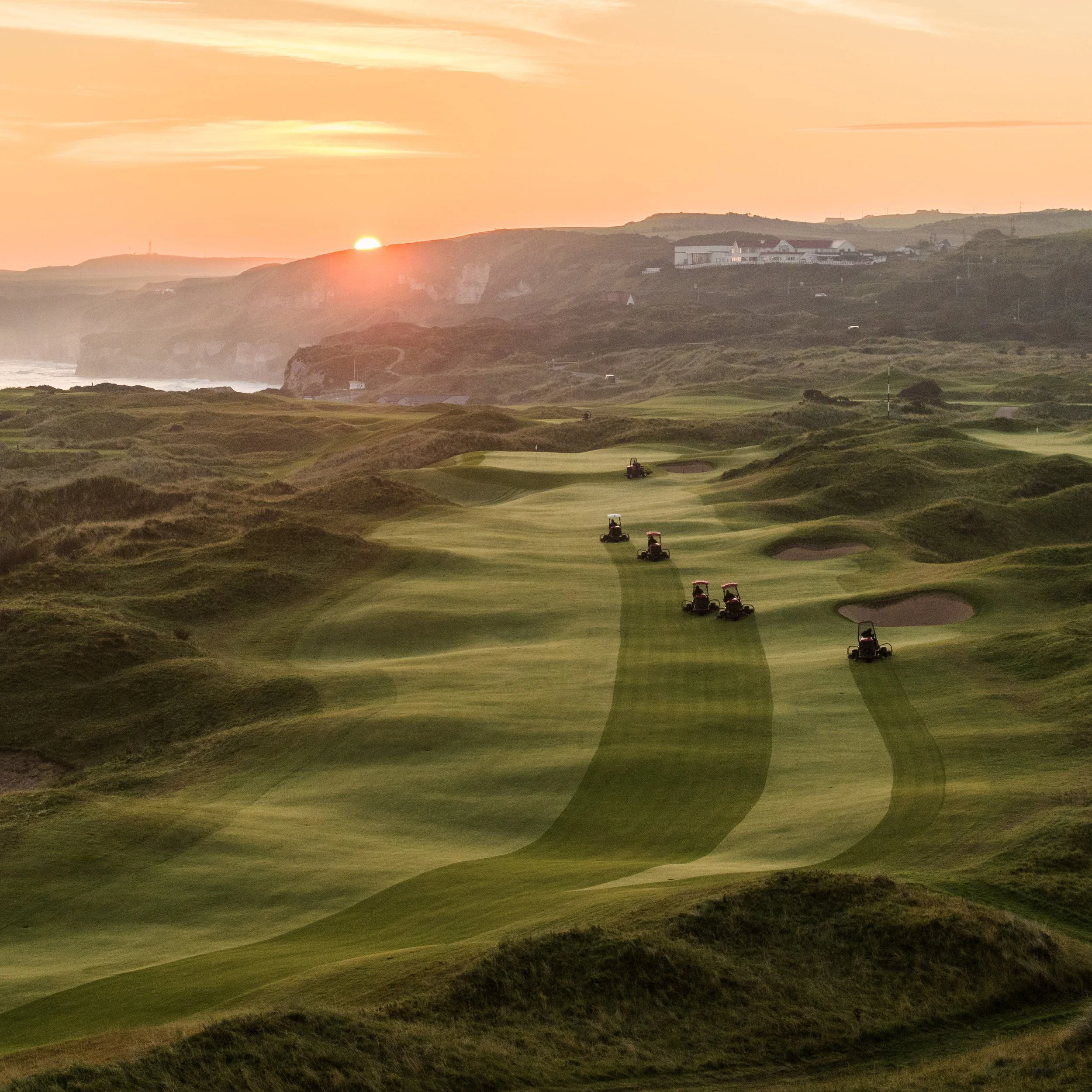
Image courtesy of Royal Portrush Golf Club / Cookie Jar Golf.
There are courses that host major championships, and then there are courses that feel like a major championship — even when it’s just you, your caddie, and the North Atlantic wind. Royal Portrush is both.
Perched on the Causeway Coast of Northern Ireland, the Dunluce Links at Royal Portrush has firmly re-established itself as one of championship golf’s great stages. After a 68-year absence, The Open returned to Portrush in 2019, won by Shane Lowry, and again in 2025, won by Scottie Scheffler, who claimed the Claret Jug with a dominant performance. Both times, the course delivered — enormous crowds, dramatic finishes, and a layout that tested the best players in the world from first tee to last green.
For American golfers making the trip to Ireland, Royal Portrush is a non-negotiable. Here’s what you need to know before you play it.
At a Glance
Course: Royal Portrush (Dunluce Links), Co. Antrim
Type: Links
Founded / opened: Club founded 1888; Dunluce Links opened 1933 (Colt design dates to 1932)
Main architects: Harry Colt (1932); Mackenzie & Ebert (championship changes, including the new 7th and 8th, for the 2019 Open)
Par / back tee yardage: Par 72; plays to more than 7,300 yards from the championship tees, depending on setup
Best paired with: Portstewart and Castlerock on the Causeway Coast
Practical note: Open venue in 1951, 2019 (Shane Lowry) and 2025 (Scottie Scheffler); an official handicap is required; around 60 minutes from Belfast.
The Course: Dunluce Links
The Dunluce Links is the championship course and the one you want to play. (Royal Portrush also has the Valley Course, which has been significantly renovated and is excellent in its own right — but Dunluce is the main event.)
Harry Colt’s Dunluce design dates to 1932, with later championship changes by Mackenzie & Ebert ahead of the 2019 Open. The long par-5 7th, Curran Point, and the par-4 8th, Dunluce, were designed by Martin Ebert of Mackenzie & Ebert on land that was formerly part of the Valley Course, replacing a pair of holes that were unsuitable for championship play. The result is a routing that flows beautifully along the coast, with each hole presenting a distinct challenge.
The course plays along rocky cliffs, through rolling dunes, and across exposed headlands where the wind seems to come from everywhere at once. On a clear day, you can see all the way to the Scottish island of Islay across the water. On a typical day, you can see about 200 yards before the mist takes over.
The Holes You’ll Remember
The 5th — “White Rocks”: A par-4 that plays along the cliff edge with the Atlantic crashing below and to the right. The tee shot is blind over a ridge of dunes, and the approach is to a green perched near the cliff. It’s visually stunning and strategically demanding — one of the most photographed holes in Ireland.
The 7th — “Curran Point”: One of the new holes built for the 2019 Open. A long, sweeping par-5 that hugs the coastline and offers a genuine risk-reward second shot to a well-guarded green. The views from this part of the course are panoramic.
The 16th — “Calamity Corner”: The most famous hole at Portrush and one of the most famous par-3s in world golf. It plays from an elevated tee to a green set on a shelf, with a deep ravine running along the right side. The name isn’t just dramatic — miss the green right and your ball will tumble down a slope that’s genuinely calamitous. It’s a hole that demands a pure strike, and the wind at the top of the hill makes club selection a guessing game.
The 17th: A short par-4 that looks simple on the card but plays devilishly tricky. The green is well-protected, and approach shots need to be precisely judged. It’s the kind of hole where you can make birdie or double bogey with equal likelihood.
What It Feels Like to Play There
Royal Portrush has the aura of a championship venue without any of the stuffiness. The clubhouse is welcoming — you’ll see members having tea alongside international visitors, and the staff treats everyone with the same warmth.
The first tee is right beside the clubhouse, and there’s often a small gallery of members and visitors watching tee shots. It’s a little nerve-wracking, especially if you know the history of the place. Take a breath, pick a target, and remember — the fairway is wider than it looks.
From the first hole onward, the course reveals itself gradually. The opening holes are inland, playing through valleys between dunes. Then, around the fifth, the course swings out toward the cliffs and the views open up. From that point, every hole has the ocean as a backdrop.
Walking Portrush is a workout. The terrain is undulating, and several holes involve significant climbs — particularly the walk up to the sixteenth tee, where Calamity Corner awaits at the top of the hill. A caddie is essential, not just for the reads but for the company. Portrush caddies are knowledgeable, opinionated, and full of stories about the famous rounds played on these fairways.
Planning Your Visit
The Dunluce Links is a championship venue that takes visitors on limited tee times, so plan early.
The course: visitors play the Dunluce Links (the Open venue); the Valley Course is the club's second eighteen.
Book well ahead: the best dates are released ~18 months in advance and go quickly, so the earlier you settle your dates the better.
Proof of handicap: an official handicap is required, and Royal Portrush applies one of the stricter limits among Irish links. Bring your home club and WHS or GHIN index, and carry proof on the day.
Caddies: a caddie is well worth it on Calamity Corner and the closing holes; availability is limited, so request one in advance.
Walking only: the round is on foot over undulating dunes and takes around four and a half hours.
Green fees: Royal Portrush sits among the highest green fees in Ireland, in keeping with an Open venue.
We arrange tee-time requests at Royal Portrush and build the trip around confirmed access.
The Verdict
Royal Portrush is everything you’ve heard and a little bit more. It’s a serious golf course that demands your best, but it rewards honest effort with views, drama, and an atmosphere that stays with you long after the round is over.
When you stand on the fifth tee and look out over the White Rocks, with the Atlantic stretching toward Scotland and the wind filling your ears, you’ll understand why The Open keeps coming back.
Royal Portrush is a flagship course in Argyle Links’ Northern Ireland packages. We arrange tee-time requests, coordinate accommodation, and arrange transport so you can focus on the golf. Get the conversation started to get your tee-times sorted today.