
Royal County Down: Why the World’s No. 1 Course Lives Up to the Hype
Reading time: 4 minutes
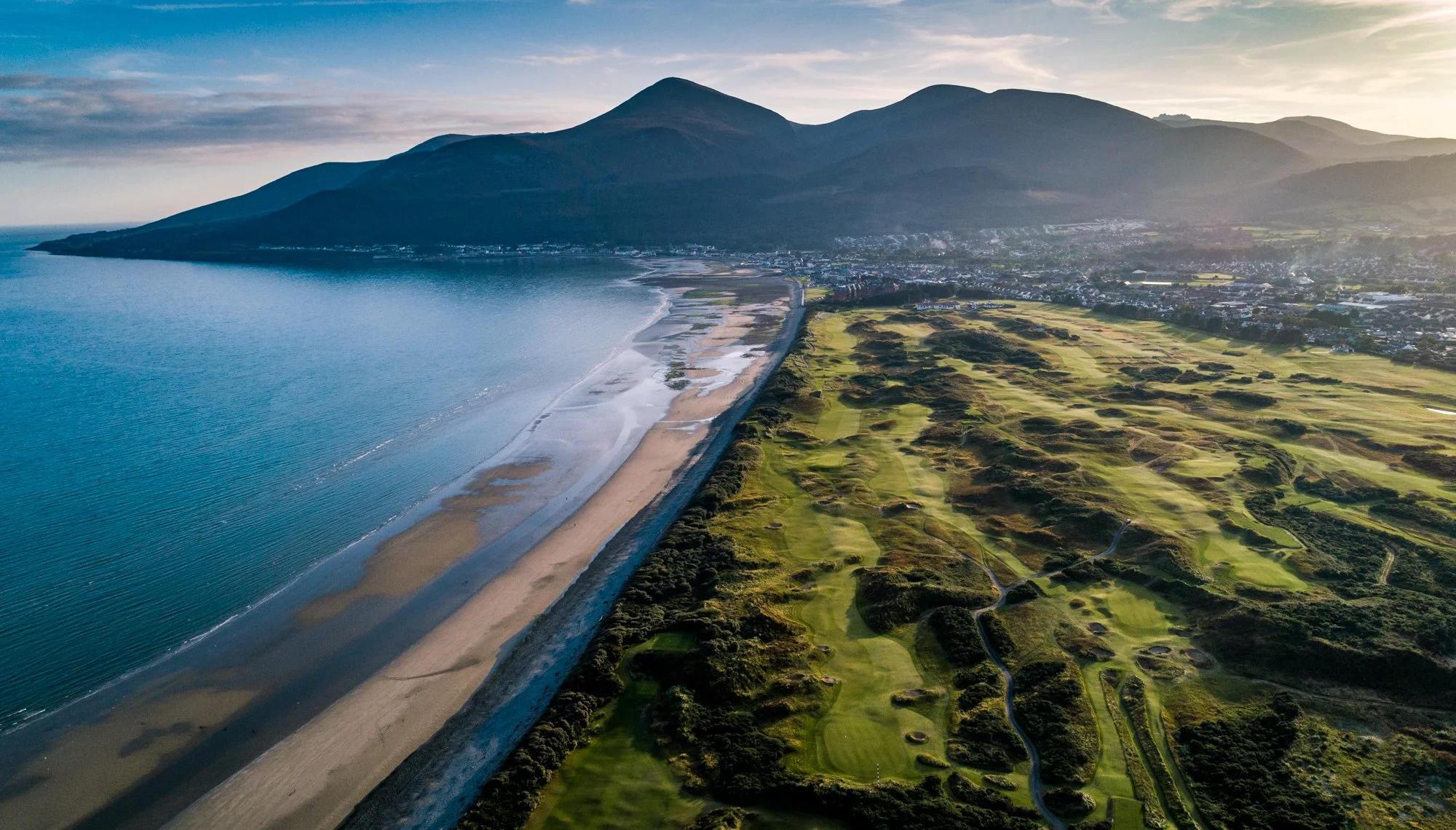
Image courtesy of Royal County Down Golf Club, used with permission.
Every golfer has a list. The courses you have to play before the game is done. Pebble Beach. Augusta. St. Andrews. But there’s one course that consistently sits at the very top of the world rankings — ahead of all of them — and most American golfers have never heard anyone in their foursome mention it.
Royal County Down, in the seaside town of Newcastle in Northern Ireland, has been ranked the number one golf course in the world by Golf Digest and numerous other publications for the better part of the last decade. It’s held its place at or near the summit of every major course ranking published in that time. And yet, compared to Pebble Beach or St. Andrews, it flies relatively under the radar.
There’s no major championship history on the men’s professional circuit. No famous final-round duel to anchor it in casual golf fans’ memories. Its reputation rests entirely on the quality of the golf course itself — and that, it turns out, is more than enough.
At a Glance
Course: Royal County Down (Championship Links), Newcastle, Co. Down
Type: Links
Founded / opened: 1889
Main architects: George L. Baillie (original nine, 1889); Old Tom Morris (advised on the extension, 1889); later shaped by George Combe, Harry Colt and Donald Steel
Par / back tee yardage: Par 71; plays to more than 7,100 yards from the championship tees, depending on setup
Best paired with: Ardglass on the Co. Down coast; Royal Portrush and the Causeway Coast on a longer Northern Ireland trip
Practical note: Wednesdays and Saturdays are generally reserved for members; walking; around 45–60 minutes from Belfast.
The Setting
Royal County Down occupies one of the most dramatic settings in world golf. The course sits at the base of the Mourne Mountains, which rise steeply behind the town of Newcastle and provide a backdrop that makes every hole feel cinematic. To the east, Dundrum Bay stretches toward the Irish Sea. The combination of mountains, sea, and towering sand dunes creates a landscape that’s almost impossibly beautiful.
The duneland here is among the most impressive anywhere. The dunes are massive — some over fifty feet high — and the course weaves through, over, and around them in ways that create an extraordinary variety of shots and views.
The Course
Royal County Down was founded in 1889. George L. Baillie was chiefly responsible for the original nine-hole layout at Newcastle, before Old Tom Morris came from St Andrews later that year to advise on extending the course. The Championship Links was subsequently shaped by George Combe, Harry Colt and Donald Steel, while retaining its extraordinary natural links character. The routing is masterful — it uses the natural terrain so effectively that the course feels less designed than discovered, as though someone simply walked through the dunes and found eighteen perfect holes waiting there.
The front nine is widely considered one of the greatest stretches of links golf in the world. It plays through the heart of the dunes, with each hole presenting a different challenge: a narrow, heather-lined fairway here, a blind tee shot over a gorse-covered ridge there, a green tucked into a natural amphitheater of sand.
The par-3 fourth is a genuine jaw-dropper — a short iron to a green set against the backdrop of the Mournes, with gorse ablaze in yellow on either side. The ninth, a long par-4 that doglegs through a valley of dunes, is one of the most thrilling approach shots you’ll ever hit.
The back nine is more open and exposed, playing along the coast with the sea in view. It’s a different kind of beautiful — wider fairways, bigger greens, and the wind as a more constant factor.
The Blind Shots
Here’s the thing about Royal County Down that surprises most first-time visitors: there are a lot of blind shots. More than any other top-ranked course in the world. Tee shots launched over dunes to fairways you can’t see. Approach shots played to greens hidden behind ridges.
For some golfers, this is frustrating. For others, it’s part of the magic — a throwback to the original links experience, where you played by memory, feel, and trust. Your caddie will be essential here, pointing you toward aiming markers and helping you visualize shots before you hit them.
The blind shots are also what makes playing Royal County Down a second time so rewarding. The first round is discovery. The second round is when you start to really play the course.
What It Feels Like
Royal County Down has an atmosphere that’s different from other top courses. It’s a private members’ club, and it feels like one — there’s a quiet formality to the experience, a sense that you’re a guest in someone’s home. The clubhouse is understated, the staff professional, and the course is presented in pristine condition.
But don’t mistake formality for unfriendliness. The welcome is warm, the caddies are excellent, and once you’re on the first tee, the only thing that matters is the golf.
Walking the course is the only option, and it’s a genuine physical challenge. The terrain is hilly, the walks between some greens and tees are long, and the soft, sandy ground requires more effort than flat parkland. Budget more energy than you think — and more time. A round at Royal County Down takes at least four hours, often closer to five.
Planning Your Visit
Royal County Down is in Newcastle, around 45–60 minutes from Belfast, traffic dependent. The town is small and charming, dominated by the massive Slieve Donard Hotel — a Victorian railway hotel that overlooks the first tee and offers one of the best golfer’s views in Ireland.
Visitor tee times are limited, particularly on weekends, so booking well in advance is essential. Weekday mornings tend to offer the best availability. Green fees are among the higher in Ireland, but given that you’re playing what many consider the finest golf course on the planet, the value proposition is hard to argue with.
Nearby courses worth pairing with Royal County Down include Ardglass, which has six spectacular opening holes perched on seaside cliffs, and Royal Belfast, the oldest club in Ireland. If you’re building a Northern Ireland itinerary, Royal Portrush and Portstewart are about ninety minutes north along the coast.
The Verdict
Royal County Down earns its ranking. It’s not the most famous course in the world, and it doesn’t have the championship pedigree of St. Andrews or Augusta. But as a pure golf experience — the combination of terrain, design, beauty, and challenge — there is genuinely nothing else quite like it.
You’ll stand on the first tee with the Mournes behind you and the dunes stretching out ahead, and you’ll understand immediately why this place sits at the top.
Planning Your Visit to Royal County Down
Royal County Down is a members' club that welcomes visitors on limited days, so a little planning goes a long way.
Visitor access: Wednesdays and Saturdays are reserved for members; weekday mornings usually offer the best visitor availability.
Book well ahead: tee times for the following year are released roughly 18 months in advance and the best dates go quickly, so the marquee links reward early planning.
Proof of handicap: an official handicap is required. Bring your home club and current WHS or GHIN index, and carry proof on the day.
Caddies: caddies are advised on this blind, dune-framed links and availability is not guaranteed, so it is worth requesting one well in advance.
Walking only: the round is on foot and takes around four and a half hours.
Royal County Down is a centerpiece of Argyle Links’ Northern Ireland packages. We arrange tee-time requests and build itineraries around confirmed access, pairing it with the best of the Causeway Coast. Contact us today to secure your tee-times.